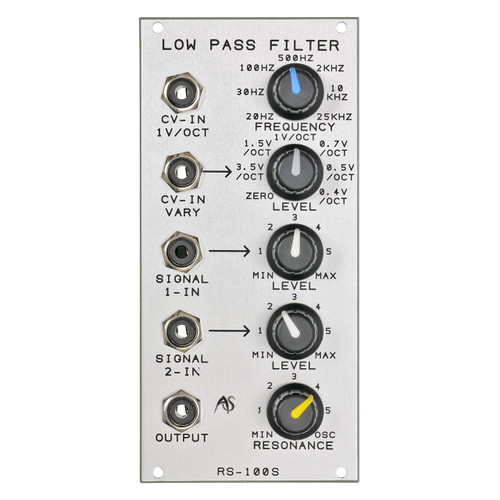


The RS-95N oscillator is a premium, british sounding VCO with waveshaping possiblities. It has a new front panel design with elongated holes.
It is based on the RS-90 but has more features, predominantly a very special sine wave.
The RS-95N presented here is technically identical but instead a normal frequency control it features a gorgeous, lockable potentiometer with ten turns. This allows precise fine tune control and adds the look of an EMS synthesiser to the VCO.
The module has three audio outputs: pulse, triangle and sine.
The upper shape control affects the pulse width. The lower shape control not only morphs from a falling sawtooth over triangle to a rising saw (or ramp) but simultaneously alters the sine wave and produces a kind of smoothed, softer sawtooth. Additionally the saw/sine output is a CV-INPUT for the symmetry of the sine. Very extraordinary feature that all are voltage controllable.
The oscillator sync is "soft" and not only reacts to square waves but works with all waveforms.
The frequency control has three switchable modes:
STD (standard) with a range of two octaves.
2 is two octaves lower than STD.
WIDE mode gives a range from 0.3 Hz - 17kHz and thus allows use of the RS-95 as VC-LFO with waveshaping options!
The "vary" control not only attenuates but also can amplify the pitch CV. It controls linearly from 0V over 1V/oct to 0.4 V/oct.
In use :
FREQUENCY
The RS-95N generates a particularly wide range of frequencies. The minimum - approximately 0.3Hz - is well into the subsonic range, so they will double as LFOs when required. This architecture emulates that of the Minimoog and larger Moog synthesisers such as the IIIC and System 55. At the upper end of the scale, they will produce frequencies of approximately 17kHz, which is beyond many people's upper limit of hearing.
WAVEFORMS
The RS-95N generates three families of waveforms. The first is the rectangular family, whose waves are generally known as pulse waves and square waves. The second is the sawtooth family that includes falling saws, triangle waves, and rising saws ('ramp'waves). The third is the sine wave and an associated family of skewed waves with unusual harmonic structures.
You can set the nature of the waveforms manually or control them dynamically using the CV-IN inputs provided for each family.
PULSE WAVE
You can adjust the pulse wave output from 0% (leading pulse) through square wave to 100% (trailing pulse) as you turn the PULSE SHAPE control from its fully anticlockwise position through to its most clockwise position. A square wave will be obtained when the knob is at 12 o'clock. You can also influence the pulse wave shape by applying a CV to the CV-IN SHAPE socket next to the PULSE SHAPE control, as follows:
A CV of +2.5V will generate a 0% duty cycle
A CV of 0V will generate a square wave
A CV of -2.5V will generate a 100% duty cycle
The output from the SQR OUTPUT socket is approximately ±5V.
SAWTOOTH / TRIANGLE WAVES
You can adjust the sawtooth wave output from a falling sawtooth through a triangle wave to a rising sawtooth (ramp) as you turn the SAWTOOTH SHAPE control from its fully anticlockwise position through to its fully clockwise position. The triangle shape will be obtained when the knob is at 12 o'clock. You can influence the sawtooth wave shape by applying a CV to the CV-IN SHAPE socket next to the SAWTOOTH SHAPE control, as follows:
A CV of +2.0V will generate a falling sawtooth wave
A CV of 0V will generate a triangle wave
A CV of -2.0V will generate a rising sawtooth (ramp) wave
The output from the SAW/TRI OUTPUT socket is -2V to +8V when a true sawtooth wave is produced, and ±2.5V when a triangle wave is produced.
SINE AND SKEWED SINE WAVES
The sine wave is a sadly underused waveform found on few analogue synthesisers. There is a good reason for this: it is not simple to generate a pure sine wave. Most oscillators with sine wave outputs generate the waveform by re-shaping another wave; usually the triangle or, if this is unavailable, the sawtooth. Analogue Systems has taken this idea a step further to build a uniquely shapeable sine wave output. There are two ways to shape the sine wave:
Using the Shape control
You can use the shared SAW/TRI/SINE SHAPE knob to generate any of the waveforms shown below, or to select a waveform that lies anywhere between these extremes. These unusual waveforms have uncommon harmonic structures, and you can use them to create timbres that you will not be able to obtain from conventional synthesisers.
Using the SINE-SHAPE CV IN
You can use SAW/TRI OUTPUT as a SINE SHAPE CV IN. This facility is unique to the RS-95N. The greater the applied CV (either positive or negative) the greater the amount of waveshaping there will be. As with the SHAPE control itself, you can use this facility to create timbres that you will not be able to obtain from conventional synthesisers.
CV-IN 1V/OCT:
The primary method of controlling the pitch is by applying a suitable CV to the CV IN socket. This respond to the 1V/Oct standard adopted by Moog, ARP, Roland and Sequential Circuits (among others). It will not allow you to play conventional melodies if you apply a CV conforming to the Hz/Volt standard used by Yamaha and on most Korg monosynths.
FREQUENCY RANGES:
WIDE: Turning the FREQUENCY control from its minimum to its maximum will cause the RS-95N to produce its full range of frequencies from 0.3Hz to 17kHz.
STD: This allows you to tune the oscillator across a full two octaves, making it possible to generate any given pitch between the -2 OCT and STD settings without applying a pitch CV. Slight detuning of one of a pair of oscillators produces a much thicker sound than would be obtained if both were in tune with each other. Radical tunings - such as fundamental with added third and fifth - offer a range of conventional 'synth' sounds.
2 OCT: This reduces the pitch of the RS-95N two octaves with respect to STD, but in all other respects the oscillator's operation is identical with the STD mode.
CV-IN VARY:
The CV-IN VARY socket and its associated LEVEL control allow you to specify the oscillator's sensitivity to pitch CV within the range ∞ V/Oct (marked "ZERO") to approximately 0.5V/Oct. The former of these makes the oscillator invariant to incoming CVs, while the latter makes it oversensitive compared to CV-IN 1V/OCT. This is particularly useful when using an RS-95 as a sync oscillator because it then becomes harmonically unrelated to the audio oscillator, thus generating a different timbre on each note that you play.
OUTPUTS:
The RS-95N offers an additional output compared with the RS-90. This allows you to obtain the sine family waveforms simultaneously with the pulse and saw/triangle waveforms.
SYNC:
Like the RS-90, the RS-95N offer oscillator sync. This allows you to re-initialise the waveform by applying a second waveform at the SYNC IN input. The waveform is re-initialised every time the voltage of the synchronising oscillator passes 0V in a positive-going direction, increasing the harmonic complexity of the waveform, and thus the range of tones that you can obtain. The most popular use for sync is to generate "tearing" or "rasping" lead and bass sounds. However, the sync on the RS-95N is softer than that of the RS-90, which makes it possible to generate a wider range of effects than before.
- Width: 12HP
- Power: 70 mA +12V
How much is my shipping?
Shipping costs are calculated automatically at checkout. Simply add items to your cart and proceed to the checkout page, where you'll see the available shipping options and their prices. VAT at the applicable rate for your country will also be displayed at checkout.
European Union orders:
- Standard shipping is free on orders over €100. Express shipping is available on orders over €100, and free on orders over €400.
- Free deliveryn and express delivery are not available to islands and remote areas including but not limited to Cyprus, Malta, Ceuta and more throughout the European Union. Add products to your cart and enter your address to confirm yoru shipping charge.
Poland orders:
- Standard shipping is free on orders over 250 PLN. Express shipping is free on orders over 500 PLN.
What about local taxes?
By default prices on the site include sales tax at 20%. The precise sales tax rate for your country will be calculated at checkout.
Do you ship to my country?
We ship to all EU member states from our warehouse in Warsaw, Poland. Add an item to your cart and enter your country and postcode to see the available shipping options and prices for your location. If you have any questions about shipping to your country, drop us an email at info@signalsounds.eu and we'll be happy to help.
Shipping methods
All EU orders are shipped via UPS. We offer two service levels:
- UPS Standard – our default shipping option. Delivery times vary by country (see estimated delivery times below).
- UPS Express Saver – next business day delivery to most EU destinations.
Each product page shows the estimated delivery time for your location, so you'll always know what to expect before you order.
Estimated delivery times (Standard shipping)
The times below are estimates in working days from dispatch, based on UPS Standard service. Express Saver delivers by the next business day to most destinations.
| Country | Estimated delivery (working days) |
|---|---|
| Austria | 2–3 |
| Belgium | 2 |
| Bulgaria | 4–5 |
| Croatia | 2–4 |
| Cyprus | 10 |
| Czechia | 2–3 |
| Denmark | 3 |
| Estonia | 2–3 |
| Finland | 3–5 |
| France | 2–4 |
| Germany | 2 |
| Greece | 5–7 |
| Hungary | 2–3 |
| Ireland | 4–6 |
| Italy | 3–5 |
| Latvia | 2–3 |
| Lithuania | 1–2 |
| Luxembourg | 2 |
| Malta | 5–7 |
| Netherlands | 2 |
| Poland | 1–2 |
| Portugal | 4–5 |
| Romania | 3–4 |
| Slovakia | 2–3 |
| Slovenia | 2–3 |
| Spain | 4 |
| Sweden | 3–5 |
These times are estimates and are not guaranteed. Delivery may occasionally take a little longer due to customs processing, local conditions, or carrier delays.
Dispatch times
Orders placed before 15:00 CET (Central European Time) on a working day are normally dispatched the same day. Orders placed after 15:00 CET, or on weekends and public holidays, will be dispatched on the next working day.
If you have an urgent order, please email us at info@signalsounds.eu before placing your order and we'll do our best to accommodate you.
Pre-orders
If a product is listed as a pre-order, it means we've ordered it from the supplier but it's not physically in stock yet. The product listing will include an estimated shipping date based on the best information we have from the supplier, but do bear in mind this is subject to change and is not a guaranteed date.
If you place an order containing a mixture of in-stock and pre-order items, we'll normally hold off on shipping anything until the pre-order item(s) have arrived, rather than splitting it into multiple shipments. If you need the in-stock items sooner, we'd recommend placing separate orders. As always, please get in touch at info@signalsounds.eu if you have questions.
Product Overview
The RS-95N oscillator is a premium, british sounding VCO with waveshaping possiblities. It has a new front panel design with elongated holes.
It is based on the RS-90 but has more features, predominantly a very special sine wave.
The RS-95N presented here is technically identical but instead a normal frequency control it features a gorgeous, lockable potentiometer with ten turns. This allows precise fine tune control and adds the look of an EMS synthesiser to the VCO.
The module has three audio outputs: pulse, triangle and sine.
The upper shape control affects the pulse width. The lower shape control not only morphs from a falling sawtooth over triangle to a rising saw (or ramp) but simultaneously alters the sine wave and produces a kind of smoothed, softer sawtooth. Additionally the saw/sine output is a CV-INPUT for the symmetry of the sine. Very extraordinary feature that all are voltage controllable.
The oscillator sync is "soft" and not only reacts to square waves but works with all waveforms.
The frequency control has three switchable modes:
STD (standard) with a range of two octaves.
2 is two octaves lower than STD.
WIDE mode gives a range from 0.3 Hz - 17kHz and thus allows use of the RS-95 as VC-LFO with waveshaping options!
The "vary" control not only attenuates but also can amplify the pitch CV. It controls linearly from 0V over 1V/oct to 0.4 V/oct.
In use :
FREQUENCY
The RS-95N generates a particularly wide range of frequencies. The minimum - approximately 0.3Hz - is well into the subsonic range, so they will double as LFOs when required. This architecture emulates that of the Minimoog and larger Moog synthesisers such as the IIIC and System 55. At the upper end of the scale, they will produce frequencies of approximately 17kHz, which is beyond many people's upper limit of hearing.
WAVEFORMS
The RS-95N generates three families of waveforms. The first is the rectangular family, whose waves are generally known as pulse waves and square waves. The second is the sawtooth family that includes falling saws, triangle waves, and rising saws ('ramp'waves). The third is the sine wave and an associated family of skewed waves with unusual harmonic structures.
You can set the nature of the waveforms manually or control them dynamically using the CV-IN inputs provided for each family.
PULSE WAVE
You can adjust the pulse wave output from 0% (leading pulse) through square wave to 100% (trailing pulse) as you turn the PULSE SHAPE control from its fully anticlockwise position through to its most clockwise position. A square wave will be obtained when the knob is at 12 o'clock. You can also influence the pulse wave shape by applying a CV to the CV-IN SHAPE socket next to the PULSE SHAPE control, as follows:
A CV of +2.5V will generate a 0% duty cycle
A CV of 0V will generate a square wave
A CV of -2.5V will generate a 100% duty cycle
The output from the SQR OUTPUT socket is approximately ±5V.
SAWTOOTH / TRIANGLE WAVES
You can adjust the sawtooth wave output from a falling sawtooth through a triangle wave to a rising sawtooth (ramp) as you turn the SAWTOOTH SHAPE control from its fully anticlockwise position through to its fully clockwise position. The triangle shape will be obtained when the knob is at 12 o'clock. You can influence the sawtooth wave shape by applying a CV to the CV-IN SHAPE socket next to the SAWTOOTH SHAPE control, as follows:
A CV of +2.0V will generate a falling sawtooth wave
A CV of 0V will generate a triangle wave
A CV of -2.0V will generate a rising sawtooth (ramp) wave
The output from the SAW/TRI OUTPUT socket is -2V to +8V when a true sawtooth wave is produced, and ±2.5V when a triangle wave is produced.
SINE AND SKEWED SINE WAVES
The sine wave is a sadly underused waveform found on few analogue synthesisers. There is a good reason for this: it is not simple to generate a pure sine wave. Most oscillators with sine wave outputs generate the waveform by re-shaping another wave; usually the triangle or, if this is unavailable, the sawtooth. Analogue Systems has taken this idea a step further to build a uniquely shapeable sine wave output. There are two ways to shape the sine wave:
Using the Shape control
You can use the shared SAW/TRI/SINE SHAPE knob to generate any of the waveforms shown below, or to select a waveform that lies anywhere between these extremes. These unusual waveforms have uncommon harmonic structures, and you can use them to create timbres that you will not be able to obtain from conventional synthesisers.
Using the SINE-SHAPE CV IN
You can use SAW/TRI OUTPUT as a SINE SHAPE CV IN. This facility is unique to the RS-95N. The greater the applied CV (either positive or negative) the greater the amount of waveshaping there will be. As with the SHAPE control itself, you can use this facility to create timbres that you will not be able to obtain from conventional synthesisers.
CV-IN 1V/OCT:
The primary method of controlling the pitch is by applying a suitable CV to the CV IN socket. This respond to the 1V/Oct standard adopted by Moog, ARP, Roland and Sequential Circuits (among others). It will not allow you to play conventional melodies if you apply a CV conforming to the Hz/Volt standard used by Yamaha and on most Korg monosynths.
FREQUENCY RANGES:
WIDE: Turning the FREQUENCY control from its minimum to its maximum will cause the RS-95N to produce its full range of frequencies from 0.3Hz to 17kHz.
STD: This allows you to tune the oscillator across a full two octaves, making it possible to generate any given pitch between the -2 OCT and STD settings without applying a pitch CV. Slight detuning of one of a pair of oscillators produces a much thicker sound than would be obtained if both were in tune with each other. Radical tunings - such as fundamental with added third and fifth - offer a range of conventional 'synth' sounds.
2 OCT: This reduces the pitch of the RS-95N two octaves with respect to STD, but in all other respects the oscillator's operation is identical with the STD mode.
CV-IN VARY:
The CV-IN VARY socket and its associated LEVEL control allow you to specify the oscillator's sensitivity to pitch CV within the range ∞ V/Oct (marked "ZERO") to approximately 0.5V/Oct. The former of these makes the oscillator invariant to incoming CVs, while the latter makes it oversensitive compared to CV-IN 1V/OCT. This is particularly useful when using an RS-95 as a sync oscillator because it then becomes harmonically unrelated to the audio oscillator, thus generating a different timbre on each note that you play.
OUTPUTS:
The RS-95N offers an additional output compared with the RS-90. This allows you to obtain the sine family waveforms simultaneously with the pulse and saw/triangle waveforms.
SYNC:
Like the RS-90, the RS-95N offer oscillator sync. This allows you to re-initialise the waveform by applying a second waveform at the SYNC IN input. The waveform is re-initialised every time the voltage of the synchronising oscillator passes 0V in a positive-going direction, increasing the harmonic complexity of the waveform, and thus the range of tones that you can obtain. The most popular use for sync is to generate "tearing" or "rasping" lead and bass sounds. However, the sync on the RS-95N is softer than that of the RS-90, which makes it possible to generate a wider range of effects than before.
Technical Specs
Shipping Details
How much is my shipping?
Shipping costs are calculated automatically at checkout. Simply add items to your cart and proceed to the checkout page, where you'll see the available shipping options and their prices. VAT at the applicable rate for your country will also be displayed at checkout.
European Union orders:
- Standard shipping is free on orders over €100. Express shipping is available on orders over €100, and free on orders over €400.
- Free deliveryn and express delivery are not available to islands and remote areas including but not limited to Cyprus, Malta, Ceuta and more throughout the European Union. Add products to your cart and enter your address to confirm yoru shipping charge.
Poland orders:
- Standard shipping is free on orders over 250 PLN. Express shipping is free on orders over 500 PLN.
What about local taxes?
By default prices on the site include sales tax at 20%. The precise sales tax rate for your country will be calculated at checkout.
Do you ship to my country?
We ship to all EU member states from our warehouse in Warsaw, Poland. Add an item to your cart and enter your country and postcode to see the available shipping options and prices for your location. If you have any questions about shipping to your country, drop us an email at info@signalsounds.eu and we'll be happy to help.
Shipping methods
All EU orders are shipped via UPS. We offer two service levels:
- UPS Standard – our default shipping option. Delivery times vary by country (see estimated delivery times below).
- UPS Express Saver – next business day delivery to most EU destinations.
Each product page shows the estimated delivery time for your location, so you'll always know what to expect before you order.
Estimated delivery times (Standard shipping)
The times below are estimates in working days from dispatch, based on UPS Standard service. Express Saver delivers by the next business day to most destinations.
| Country | Estimated delivery (working days) |
|---|---|
| Austria | 2–3 |
| Belgium | 2 |
| Bulgaria | 4–5 |
| Croatia | 2–4 |
| Cyprus | 10 |
| Czechia | 2–3 |
| Denmark | 3 |
| Estonia | 2–3 |
| Finland | 3–5 |
| France | 2–4 |
| Germany | 2 |
| Greece | 5–7 |
| Hungary | 2–3 |
| Ireland | 4–6 |
| Italy | 3–5 |
| Latvia | 2–3 |
| Lithuania | 1–2 |
| Luxembourg | 2 |
| Malta | 5–7 |
| Netherlands | 2 |
| Poland | 1–2 |
| Portugal | 4–5 |
| Romania | 3–4 |
| Slovakia | 2–3 |
| Slovenia | 2–3 |
| Spain | 4 |
| Sweden | 3–5 |
These times are estimates and are not guaranteed. Delivery may occasionally take a little longer due to customs processing, local conditions, or carrier delays.
Dispatch times
Orders placed before 15:00 CET (Central European Time) on a working day are normally dispatched the same day. Orders placed after 15:00 CET, or on weekends and public holidays, will be dispatched on the next working day.
If you have an urgent order, please email us at info@signalsounds.eu before placing your order and we'll do our best to accommodate you.
Pre-orders
If a product is listed as a pre-order, it means we've ordered it from the supplier but it's not physically in stock yet. The product listing will include an estimated shipping date based on the best information we have from the supplier, but do bear in mind this is subject to change and is not a guaranteed date.
If you place an order containing a mixture of in-stock and pre-order items, we'll normally hold off on shipping anything until the pre-order item(s) have arrived, rather than splitting it into multiple shipments. If you need the in-stock items sooner, we'd recommend placing separate orders. As always, please get in touch at info@signalsounds.eu if you have questions.