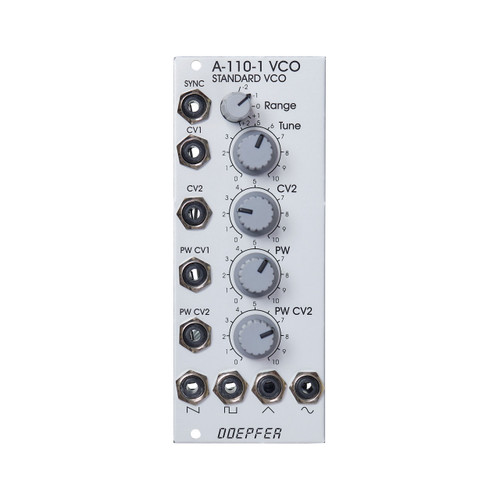


A-110-4 is a so-called Thru Zero Quadrature VCO. The term "quadrature" means in this connection that the oscillator outputs sine and cosine waveforms simultaneously. The term "Thru-Zero" means that even "negative" frequencies are generated. But this a bit a misleading term as negative frequencies do not really exist. "Negative" means in this connection simply that the sine/cosine waves will stop when the linear control voltage reaches 0V and continue with the opposite direction as the linear control voltage becomes negative and vice versa.
The module has two control sections: linear and a exponential. The exponential section consists of the XTune control, the 1V/Oct input and the XFM input with the corresponding attenuator XFM. The exponential control voltage is the sum of these three voltages. The linear section consists of the LFrq control and the LFM input with the corresponding attenuator LFM. The linear control voltage is the sum of these two voltages. A dual color LED is used to display the polarity of the linear control voltage (red = positive, yellow = negative). The pitch of the sine/cosine outputs is determined by the control voltages of both sections. The linear section is used to control the pitch in a linear manner. When the LFrq control (LFrq means Linear Frequency Control) is fully CW the module works like a normal Quadrature VCO (e.g. like the A-143-9) and the LED lights red (red = positive). The pitch is then controlled by the exponential section with the manual Tune control XTune and the exponential frequency control inputs 1V/Oct and XFM. 1V/Oct is used to control the pitch by a 1V/Oct CV source (e.g. sequencer or Midi/USB-to-CV interface). XFM is used to apply an exponential frequency modulation with adjustable depth (e.g. from an LFO or another VCO). As the LFrq control is turned counterclockwise starting from the fully CW position the frequency is lowered in a linear manner until the sine/cosine waves (nearly) stops at the center position of LFrq (provided that no LFM signal is present). As the LFrq control is moved from the center towards the CCW position the wave starts again but into reverse direction and the LED turns yellow. When the fully CCW position of LFrq is reached the module works again like a normal Quadrature VCO. But much more exciting is the usage of the LFM input to modify the linear control voltage by an external control voltage (typically another sine VCO like a second A-110-4 - but even normal VCOs can be used). Linear modulation by another oscillator using the thru zero feature generates audio spectra than cannot be obtained from an oscillator without the thru zero function. The reason is that a "normal" VCO will simply stop as the linear control voltage becomes zero or negative. But a thru zero VCO will start again with "negative" frequencies as the the linear control voltage becomes negative.
The main advantage of the A-110-4 compared to other Thru Zero VCOs is that the design uses a sine/cosine core. The sine/cosine waves are not derived from other waveforms (e.g. sawtooth or triangle) by means of waveshaping. Rather the sine and cosine waves are the core of the VCO which results in very pure waves with a minimum of distortion and overtones.
The output level is about 10Vpp (please refer to the note at the bottom for the output level of older versions).
Important note: Please remove the bus jumper (JP3 "BUS CV") if no CV transmitter is installed on the same bus (e.g. a Midi/USB-to-CV interface A-190-x or a bus access module A-185-x). The A-110-4 applies a small voltage with high impedance (100k) to the CV line of the bus when the bus CV jumper is installed. This may affect other modules that pick-up CV from the bus (e.g. other VCOs). As soon as a CV transmitter is installed on the same bus the high impedance voltage of the A-110-4 is overwritten and no problem occurs !
Additional technical notes:
The document A110_4_trimming_potentiometers.pdf explains the functions of the trimming potentiometers. The document is planned only for experienced users ! Please do not change the settings of the trimming potentiometers unless you are sure that you want to change certain settings. Modules which are returned with (mis-)adjusted trimming potentiometers cannot be treated as case of warranty !
In the factory the module is ajusted for these frequencies (with LFrq fully CW and XTune in the according position so that an external 5.00V control voltage generates 1024 Hz, i.e. the +5V CV is the reference setting with 0Hz error):
0.00V: 32 Hz ± 0.2Hz
1.00V: 64 Hz ± 0.5 Hz
2.00V: 128 Hz ± 1Hz
3.00V: 256 Hz ± 1Hz
4.00V: 512 Hz ± 2Hz5
5.00V: 1024 Hz ± 0Hz
Socket 1V/Oct is normalled to the internal control voltage coming from the bus (interruptible by removing the jumper JP3). Plugging a patch cable into the socket 1V/Oct does interrupt the internal bus CV connection ! Other VCO modules may behave different in this regard (e.g. adding the internal bus CV to the CV applied to the socket at the front panel).
The control voltage applied to the socket 1V/Oct is added to the control voltage coming from the bus (interruptible by removing the jumper JP3). Connecting a cable to the socket 1V/Oct does not interrupt the bus CV connection !
It is also possible to convert the A-110-4 into a Thru Zero Quadrature VCLFO by adding two capacitors to the frequency determining capacitors (C1 and C2). For details please refer to the document A110_4_trimming_potentiometers.pdf.
- Width: 8HP
- Depth: 60mm
- Power: 90 mA +12V / 30 mA -12V / 0 mA 5V
How much is my shipping?
Shipping costs are calculated automatically at checkout. Simply add items to your cart and proceed to the checkout page, where you'll see the available shipping options and their prices. VAT at the applicable rate for your country will also be displayed at checkout.
European Union orders:
- Standard shipping is free on orders over €100. Express shipping is available on orders over €100, and free on orders over €400.
- Free deliveryn and express delivery are not available to islands and remote areas including but not limited to Cyprus, Malta, Ceuta and more throughout the European Union. Add products to your cart and enter your address to confirm yoru shipping charge.
Poland orders:
- Standard shipping is free on orders over 250 PLN. Express shipping is free on orders over 500 PLN.
What about local taxes?
By default prices on the site include sales tax at 20%. The precise sales tax rate for your country will be calculated at checkout.
Do you ship to my country?
We ship to all EU member states from our warehouse in Warsaw, Poland. Add an item to your cart and enter your country and postcode to see the available shipping options and prices for your location. If you have any questions about shipping to your country, drop us an email at info@signalsounds.eu and we'll be happy to help.
Shipping methods
All EU orders are shipped via UPS. We offer two service levels:
- UPS Standard – our default shipping option. Delivery times vary by country (see estimated delivery times below).
- UPS Express Saver – next business day delivery to most EU destinations.
Each product page shows the estimated delivery time for your location, so you'll always know what to expect before you order.
Estimated delivery times (Standard shipping)
The times below are estimates in working days from dispatch, based on UPS Standard service. Express Saver delivers by the next business day to most destinations.
| Country | Estimated delivery (working days) |
|---|---|
| Austria | 2–3 |
| Belgium | 2 |
| Bulgaria | 4–5 |
| Croatia | 2–4 |
| Cyprus | 10 |
| Czechia | 2–3 |
| Denmark | 3 |
| Estonia | 2–3 |
| Finland | 3–5 |
| France | 2–4 |
| Germany | 2 |
| Greece | 5–7 |
| Hungary | 2–3 |
| Ireland | 4–6 |
| Italy | 3–5 |
| Latvia | 2–3 |
| Lithuania | 1–2 |
| Luxembourg | 2 |
| Malta | 5–7 |
| Netherlands | 2 |
| Poland | 1–2 |
| Portugal | 4–5 |
| Romania | 3–4 |
| Slovakia | 2–3 |
| Slovenia | 2–3 |
| Spain | 4 |
| Sweden | 3–5 |
These times are estimates and are not guaranteed. Delivery may occasionally take a little longer due to customs processing, local conditions, or carrier delays.
Dispatch times
Orders placed before 15:00 CET (Central European Time) on a working day are normally dispatched the same day. Orders placed after 15:00 CET, or on weekends and public holidays, will be dispatched on the next working day.
If you have an urgent order, please email us at info@signalsounds.eu before placing your order and we'll do our best to accommodate you.
Pre-orders
If a product is listed as a pre-order, it means we've ordered it from the supplier but it's not physically in stock yet. The product listing will include an estimated shipping date based on the best information we have from the supplier, but do bear in mind this is subject to change and is not a guaranteed date.
If you place an order containing a mixture of in-stock and pre-order items, we'll normally hold off on shipping anything until the pre-order item(s) have arrived, rather than splitting it into multiple shipments. If you need the in-stock items sooner, we'd recommend placing separate orders. As always, please get in touch at info@signalsounds.eu if you have questions.
Product Overview
A-110-4 is a so-called Thru Zero Quadrature VCO. The term "quadrature" means in this connection that the oscillator outputs sine and cosine waveforms simultaneously. The term "Thru-Zero" means that even "negative" frequencies are generated. But this a bit a misleading term as negative frequencies do not really exist. "Negative" means in this connection simply that the sine/cosine waves will stop when the linear control voltage reaches 0V and continue with the opposite direction as the linear control voltage becomes negative and vice versa.
The module has two control sections: linear and a exponential. The exponential section consists of the XTune control, the 1V/Oct input and the XFM input with the corresponding attenuator XFM. The exponential control voltage is the sum of these three voltages. The linear section consists of the LFrq control and the LFM input with the corresponding attenuator LFM. The linear control voltage is the sum of these two voltages. A dual color LED is used to display the polarity of the linear control voltage (red = positive, yellow = negative). The pitch of the sine/cosine outputs is determined by the control voltages of both sections. The linear section is used to control the pitch in a linear manner. When the LFrq control (LFrq means Linear Frequency Control) is fully CW the module works like a normal Quadrature VCO (e.g. like the A-143-9) and the LED lights red (red = positive). The pitch is then controlled by the exponential section with the manual Tune control XTune and the exponential frequency control inputs 1V/Oct and XFM. 1V/Oct is used to control the pitch by a 1V/Oct CV source (e.g. sequencer or Midi/USB-to-CV interface). XFM is used to apply an exponential frequency modulation with adjustable depth (e.g. from an LFO or another VCO). As the LFrq control is turned counterclockwise starting from the fully CW position the frequency is lowered in a linear manner until the sine/cosine waves (nearly) stops at the center position of LFrq (provided that no LFM signal is present). As the LFrq control is moved from the center towards the CCW position the wave starts again but into reverse direction and the LED turns yellow. When the fully CCW position of LFrq is reached the module works again like a normal Quadrature VCO. But much more exciting is the usage of the LFM input to modify the linear control voltage by an external control voltage (typically another sine VCO like a second A-110-4 - but even normal VCOs can be used). Linear modulation by another oscillator using the thru zero feature generates audio spectra than cannot be obtained from an oscillator without the thru zero function. The reason is that a "normal" VCO will simply stop as the linear control voltage becomes zero or negative. But a thru zero VCO will start again with "negative" frequencies as the the linear control voltage becomes negative.
The main advantage of the A-110-4 compared to other Thru Zero VCOs is that the design uses a sine/cosine core. The sine/cosine waves are not derived from other waveforms (e.g. sawtooth or triangle) by means of waveshaping. Rather the sine and cosine waves are the core of the VCO which results in very pure waves with a minimum of distortion and overtones.
The output level is about 10Vpp (please refer to the note at the bottom for the output level of older versions).
Important note: Please remove the bus jumper (JP3 "BUS CV") if no CV transmitter is installed on the same bus (e.g. a Midi/USB-to-CV interface A-190-x or a bus access module A-185-x). The A-110-4 applies a small voltage with high impedance (100k) to the CV line of the bus when the bus CV jumper is installed. This may affect other modules that pick-up CV from the bus (e.g. other VCOs). As soon as a CV transmitter is installed on the same bus the high impedance voltage of the A-110-4 is overwritten and no problem occurs !
Additional technical notes:
The document A110_4_trimming_potentiometers.pdf explains the functions of the trimming potentiometers. The document is planned only for experienced users ! Please do not change the settings of the trimming potentiometers unless you are sure that you want to change certain settings. Modules which are returned with (mis-)adjusted trimming potentiometers cannot be treated as case of warranty !
In the factory the module is ajusted for these frequencies (with LFrq fully CW and XTune in the according position so that an external 5.00V control voltage generates 1024 Hz, i.e. the +5V CV is the reference setting with 0Hz error):
0.00V: 32 Hz ± 0.2Hz
1.00V: 64 Hz ± 0.5 Hz
2.00V: 128 Hz ± 1Hz
3.00V: 256 Hz ± 1Hz
4.00V: 512 Hz ± 2Hz5
5.00V: 1024 Hz ± 0Hz
Socket 1V/Oct is normalled to the internal control voltage coming from the bus (interruptible by removing the jumper JP3). Plugging a patch cable into the socket 1V/Oct does interrupt the internal bus CV connection ! Other VCO modules may behave different in this regard (e.g. adding the internal bus CV to the CV applied to the socket at the front panel).
The control voltage applied to the socket 1V/Oct is added to the control voltage coming from the bus (interruptible by removing the jumper JP3). Connecting a cable to the socket 1V/Oct does not interrupt the bus CV connection !
It is also possible to convert the A-110-4 into a Thru Zero Quadrature VCLFO by adding two capacitors to the frequency determining capacitors (C1 and C2). For details please refer to the document A110_4_trimming_potentiometers.pdf.
Technical Specs
Shipping Details
How much is my shipping?
Shipping costs are calculated automatically at checkout. Simply add items to your cart and proceed to the checkout page, where you'll see the available shipping options and their prices. VAT at the applicable rate for your country will also be displayed at checkout.
European Union orders:
- Standard shipping is free on orders over €100. Express shipping is available on orders over €100, and free on orders over €400.
- Free deliveryn and express delivery are not available to islands and remote areas including but not limited to Cyprus, Malta, Ceuta and more throughout the European Union. Add products to your cart and enter your address to confirm yoru shipping charge.
Poland orders:
- Standard shipping is free on orders over 250 PLN. Express shipping is free on orders over 500 PLN.
What about local taxes?
By default prices on the site include sales tax at 20%. The precise sales tax rate for your country will be calculated at checkout.
Do you ship to my country?
We ship to all EU member states from our warehouse in Warsaw, Poland. Add an item to your cart and enter your country and postcode to see the available shipping options and prices for your location. If you have any questions about shipping to your country, drop us an email at info@signalsounds.eu and we'll be happy to help.
Shipping methods
All EU orders are shipped via UPS. We offer two service levels:
- UPS Standard – our default shipping option. Delivery times vary by country (see estimated delivery times below).
- UPS Express Saver – next business day delivery to most EU destinations.
Each product page shows the estimated delivery time for your location, so you'll always know what to expect before you order.
Estimated delivery times (Standard shipping)
The times below are estimates in working days from dispatch, based on UPS Standard service. Express Saver delivers by the next business day to most destinations.
| Country | Estimated delivery (working days) |
|---|---|
| Austria | 2–3 |
| Belgium | 2 |
| Bulgaria | 4–5 |
| Croatia | 2–4 |
| Cyprus | 10 |
| Czechia | 2–3 |
| Denmark | 3 |
| Estonia | 2–3 |
| Finland | 3–5 |
| France | 2–4 |
| Germany | 2 |
| Greece | 5–7 |
| Hungary | 2–3 |
| Ireland | 4–6 |
| Italy | 3–5 |
| Latvia | 2–3 |
| Lithuania | 1–2 |
| Luxembourg | 2 |
| Malta | 5–7 |
| Netherlands | 2 |
| Poland | 1–2 |
| Portugal | 4–5 |
| Romania | 3–4 |
| Slovakia | 2–3 |
| Slovenia | 2–3 |
| Spain | 4 |
| Sweden | 3–5 |
These times are estimates and are not guaranteed. Delivery may occasionally take a little longer due to customs processing, local conditions, or carrier delays.
Dispatch times
Orders placed before 15:00 CET (Central European Time) on a working day are normally dispatched the same day. Orders placed after 15:00 CET, or on weekends and public holidays, will be dispatched on the next working day.
If you have an urgent order, please email us at info@signalsounds.eu before placing your order and we'll do our best to accommodate you.
Pre-orders
If a product is listed as a pre-order, it means we've ordered it from the supplier but it's not physically in stock yet. The product listing will include an estimated shipping date based on the best information we have from the supplier, but do bear in mind this is subject to change and is not a guaranteed date.
If you place an order containing a mixture of in-stock and pre-order items, we'll normally hold off on shipping anything until the pre-order item(s) have arrived, rather than splitting it into multiple shipments. If you need the in-stock items sooner, we'd recommend placing separate orders. As always, please get in touch at info@signalsounds.eu if you have questions.