

We say...
A deceptively simple sequencer from the Eurorack OGs! 8-step sequencers are always a lot of fun in a modular system, and this one has a bunch of cool extra features that elevate it above the average, like multiple playback modes and those all-important ratchets!
Manufacturer's description
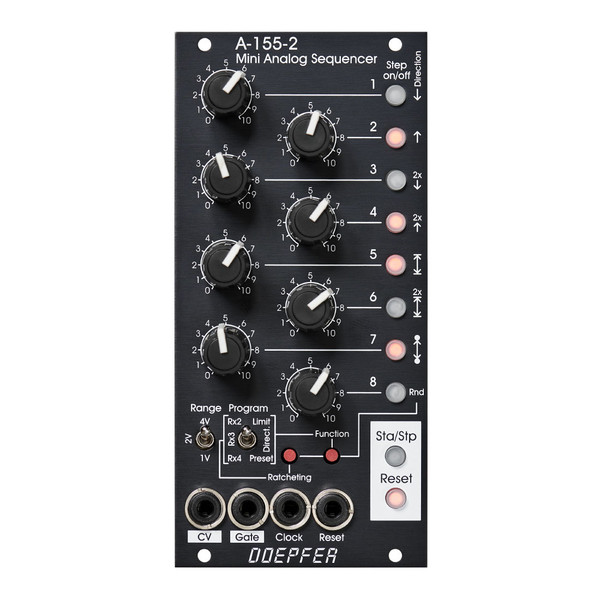
Module A-155-2 is a small, very compact designed analog sequencer with a lot of features. The sequence length is 8 steps. Each step has available a control for the adjustment of the control voltage for this step and an illuminated momentary switch (button). The buttons are used in the standard running mode to turn on/off the gate of the step in question (button illuminated = gate on, not illuminated = gate off).
In combination with other controls at the bottom of the front panel the buttons are used for additional functions: depending on the position of the Program toggle switch the button Function is used to program the length of the sequence (switch position Limit), the running direction (switch position Direct.) or to call up the preset management (switch position Preset) .
When function Direct. (Direction) is selected these running modes are available:
- Up
- Down
- 2 x Up (each step is played twice with the normal tempo, not to be confused with Ratcheting x2, see below)
- 2 x Down (each step is played twice with the normal tempo, not to be confused with Ratcheting x2, see below)
- Pendulum type 1 (start and end step are played twice)
- 2 x Pendulum type 1 (each step is played twice with the normal tempo, start and end step are played 4x)
- Pendulum type 2 (start and end step are played once)
- Random (Rnd)
When function Preset is selected the illuminated buttons are used to call up one of the 8 presets. In each preset these parameters are stored: active steps, running direction, length of the sequence, ratcheting. To call up one of the 8 stored presets one has to push and hold the button Function and then operate short-time one of the buttons 1...8 while the toggle switch Program is in position Preset. To store the present paramaters in one of the 8 presets the procedure is similar but one has to operate one of the buttons 1...8 for a longer time (~ 3 seconds).
Depending on the position of the Program toggle switch the Ratcheting button is used to program the ratcheting feature (x2, x3, x4) individually for each step of the sequence (toggle switch Program in position Rx2, Rx3 or Rx4). In case that at the step in question another ratcheting is already programmed (e.g. x2 or x3 when x4 is chosen) the other ratcheting is overwritten (kind of radio button function between the ratchetings x2, x3 and x4). Details about the ratcheting function are explained at the module A-160-5.
The button Start/Stop is used to start or stop the sequence manually. Button Reset sets the sequence to the first step. For this also the external input Reset can be used.
The module does not feature built in clock generator. Rather an external Clock signal is used. The positive edge of the incoming clock signal triggers the advance of the sequence to the next step.
The voltage range of the control voltage generated by the module can be switched to 3 different ranges by the toggle switch Range: 0...+1V / 0...+2V / 0...+4V. The control voltage is available at socket CV. The voltage is not quantized. But there is an internal pin header available that outputs the data via Midi (note on/off from Midi note 36. Midi channel 1). It can be used to control a Midi-to-CV interface if quantized control voltages are required, e.g. the planned Micro-CV-Interface A-190-9).
The Gate signal appears at socket Gate. The pulsewidth of the gate signal is defined by the pulsewidth of the clock signal provided that ratcheting is not active at the step in question.
Controls and displays
- 1...8 (rotary controls): manual adjustment of the control voltage for each step
- 1...8 (illuminated momentary switches/buttons): manual gate setting for each step, also used for special functions in combination with other controls (setting of first/last step, running direction, ratcheting)
- Range: toggle switch for selection of the control voltage range
- Program: toggle switch for selection of a function in combination with the buttons Ratcheting and Function
- Ratcheting: button for the programming of ratcheting in combination with the toggle switch Program
- Function: button for the programming of sequence length (Limit) and running direction (Direct.), as well as for the Preset management (Preset)
- Sta/Stp: button for the manual control of Start and Stop, in running state the LED of this button displays the state of the Gate output (i.e. it flashes in the rhythm of the Gate output)
- Reset : manual reset button
- CV : control voltage output
- Gate : gate output
- Clock: clock input, the pulsewidth of the clocjk signal defines the pulsewidth gate signal
- Reset: reset control input, reset type selectable via internal jumpers (e.g. positive edge triggers the jump to first step / positive leveltriggers the jump to first step and remains at first step as long as the reset input is high / waiting for the next positive edge of the clock signals before reset is carried out / ...)
Technical details
- Gate output voltage: about 0V/+10V
- Required clock input level: min. +3V
- Required reset input level: min. +3V
- Max. clock frequency: >10kHz (e.g. for graphic VCO application)
- Internal MIDI output: Midi channel 1, Midi note range 36-48, 36-60 or 36-72 according to the setting of the range switch
- Width: 12HP
- Depth: 50mm
- Power: 50 mA +12V / 20 mA -12V / 0 mA 5V
How much is my shipping?
Shipping costs are calculated automatically at checkout. Simply add items to your cart and proceed to the checkout page, where you'll see the available shipping options and their prices. VAT at the applicable rate for your country will also be displayed at checkout.
European Union orders:
- Standard shipping is free on orders over €100. Express shipping is available on orders over €100, and free on orders over €400.
- Free deliveryn and express delivery are not available to islands and remote areas including but not limited to Cyprus, Malta, Ceuta and more throughout the European Union. Add products to your cart and enter your address to confirm yoru shipping charge.
Poland orders:
- Standard shipping is free on orders over 250 PLN. Express shipping is free on orders over 500 PLN.
What about local taxes?
By default prices on the site include sales tax at 20%. The precise sales tax rate for your country will be calculated at checkout.
Do you ship to my country?
We ship to all EU member states from our warehouse in Warsaw, Poland. Add an item to your cart and enter your country and postcode to see the available shipping options and prices for your location. If you have any questions about shipping to your country, drop us an email at info@signalsounds.eu and we'll be happy to help.
Shipping methods
All EU orders are shipped via UPS. We offer two service levels:
- UPS Standard – our default shipping option. Delivery times vary by country (see estimated delivery times below).
- UPS Express Saver – next business day delivery to most EU destinations.
Each product page shows the estimated delivery time for your location, so you'll always know what to expect before you order.
Estimated delivery times (Standard shipping)
The times below are estimates in working days from dispatch, based on UPS Standard service. Express Saver delivers by the next business day to most destinations.
| Country | Estimated delivery (working days) |
|---|---|
| Austria | 2–3 |
| Belgium | 2 |
| Bulgaria | 4–5 |
| Croatia | 2–4 |
| Cyprus | 10 |
| Czechia | 2–3 |
| Denmark | 3 |
| Estonia | 2–3 |
| Finland | 3–5 |
| France | 2–4 |
| Germany | 2 |
| Greece | 5–7 |
| Hungary | 2–3 |
| Ireland | 4–6 |
| Italy | 3–5 |
| Latvia | 2–3 |
| Lithuania | 1–2 |
| Luxembourg | 2 |
| Malta | 5–7 |
| Netherlands | 2 |
| Poland | 1–2 |
| Portugal | 4–5 |
| Romania | 3–4 |
| Slovakia | 2–3 |
| Slovenia | 2–3 |
| Spain | 4 |
| Sweden | 3–5 |
These times are estimates and are not guaranteed. Delivery may occasionally take a little longer due to customs processing, local conditions, or carrier delays.
Dispatch times
Orders placed before 15:00 CET (Central European Time) on a working day are normally dispatched the same day. Orders placed after 15:00 CET, or on weekends and public holidays, will be dispatched on the next working day.
If you have an urgent order, please email us at info@signalsounds.eu before placing your order and we'll do our best to accommodate you.
Pre-orders
If a product is listed as a pre-order, it means we've ordered it from the supplier but it's not physically in stock yet. The product listing will include an estimated shipping date based on the best information we have from the supplier, but do bear in mind this is subject to change and is not a guaranteed date.
If you place an order containing a mixture of in-stock and pre-order items, we'll normally hold off on shipping anything until the pre-order item(s) have arrived, rather than splitting it into multiple shipments. If you need the in-stock items sooner, we'd recommend placing separate orders. As always, please get in touch at info@signalsounds.eu if you have questions.
Product Overview
We say...
A deceptively simple sequencer from the Eurorack OGs! 8-step sequencers are always a lot of fun in a modular system, and this one has a bunch of cool extra features that elevate it above the average, like multiple playback modes and those all-important ratchets!
Manufacturer's description
Module A-155-2 is a small, very compact designed analog sequencer with a lot of features. The sequence length is 8 steps. Each step has available a control for the adjustment of the control voltage for this step and an illuminated momentary switch (button). The buttons are used in the standard running mode to turn on/off the gate of the step in question (button illuminated = gate on, not illuminated = gate off).
In combination with other controls at the bottom of the front panel the buttons are used for additional functions: depending on the position of the Program toggle switch the button Function is used to program the length of the sequence (switch position Limit), the running direction (switch position Direct.) or to call up the preset management (switch position Preset) .
When function Direct. (Direction) is selected these running modes are available:
- Up
- Down
- 2 x Up (each step is played twice with the normal tempo, not to be confused with Ratcheting x2, see below)
- 2 x Down (each step is played twice with the normal tempo, not to be confused with Ratcheting x2, see below)
- Pendulum type 1 (start and end step are played twice)
- 2 x Pendulum type 1 (each step is played twice with the normal tempo, start and end step are played 4x)
- Pendulum type 2 (start and end step are played once)
- Random (Rnd)
When function Preset is selected the illuminated buttons are used to call up one of the 8 presets. In each preset these parameters are stored: active steps, running direction, length of the sequence, ratcheting. To call up one of the 8 stored presets one has to push and hold the button Function and then operate short-time one of the buttons 1...8 while the toggle switch Program is in position Preset. To store the present paramaters in one of the 8 presets the procedure is similar but one has to operate one of the buttons 1...8 for a longer time (~ 3 seconds).
Depending on the position of the Program toggle switch the Ratcheting button is used to program the ratcheting feature (x2, x3, x4) individually for each step of the sequence (toggle switch Program in position Rx2, Rx3 or Rx4). In case that at the step in question another ratcheting is already programmed (e.g. x2 or x3 when x4 is chosen) the other ratcheting is overwritten (kind of radio button function between the ratchetings x2, x3 and x4). Details about the ratcheting function are explained at the module A-160-5.
The button Start/Stop is used to start or stop the sequence manually. Button Reset sets the sequence to the first step. For this also the external input Reset can be used.
The module does not feature built in clock generator. Rather an external Clock signal is used. The positive edge of the incoming clock signal triggers the advance of the sequence to the next step.
The voltage range of the control voltage generated by the module can be switched to 3 different ranges by the toggle switch Range: 0...+1V / 0...+2V / 0...+4V. The control voltage is available at socket CV. The voltage is not quantized. But there is an internal pin header available that outputs the data via Midi (note on/off from Midi note 36. Midi channel 1). It can be used to control a Midi-to-CV interface if quantized control voltages are required, e.g. the planned Micro-CV-Interface A-190-9).
The Gate signal appears at socket Gate. The pulsewidth of the gate signal is defined by the pulsewidth of the clock signal provided that ratcheting is not active at the step in question.
Controls and displays
- 1...8 (rotary controls): manual adjustment of the control voltage for each step
- 1...8 (illuminated momentary switches/buttons): manual gate setting for each step, also used for special functions in combination with other controls (setting of first/last step, running direction, ratcheting)
- Range: toggle switch for selection of the control voltage range
- Program: toggle switch for selection of a function in combination with the buttons Ratcheting and Function
- Ratcheting: button for the programming of ratcheting in combination with the toggle switch Program
- Function: button for the programming of sequence length (Limit) and running direction (Direct.), as well as for the Preset management (Preset)
- Sta/Stp: button for the manual control of Start and Stop, in running state the LED of this button displays the state of the Gate output (i.e. it flashes in the rhythm of the Gate output)
- Reset : manual reset button
- CV : control voltage output
- Gate : gate output
- Clock: clock input, the pulsewidth of the clocjk signal defines the pulsewidth gate signal
- Reset: reset control input, reset type selectable via internal jumpers (e.g. positive edge triggers the jump to first step / positive leveltriggers the jump to first step and remains at first step as long as the reset input is high / waiting for the next positive edge of the clock signals before reset is carried out / ...)
Technical details
- Gate output voltage: about 0V/+10V
- Required clock input level: min. +3V
- Required reset input level: min. +3V
- Max. clock frequency: >10kHz (e.g. for graphic VCO application)
- Internal MIDI output: Midi channel 1, Midi note range 36-48, 36-60 or 36-72 according to the setting of the range switch
Technical Specs
Shipping Details
How much is my shipping?
Shipping costs are calculated automatically at checkout. Simply add items to your cart and proceed to the checkout page, where you'll see the available shipping options and their prices. VAT at the applicable rate for your country will also be displayed at checkout.
European Union orders:
- Standard shipping is free on orders over €100. Express shipping is available on orders over €100, and free on orders over €400.
- Free deliveryn and express delivery are not available to islands and remote areas including but not limited to Cyprus, Malta, Ceuta and more throughout the European Union. Add products to your cart and enter your address to confirm yoru shipping charge.
Poland orders:
- Standard shipping is free on orders over 250 PLN. Express shipping is free on orders over 500 PLN.
What about local taxes?
By default prices on the site include sales tax at 20%. The precise sales tax rate for your country will be calculated at checkout.
Do you ship to my country?
We ship to all EU member states from our warehouse in Warsaw, Poland. Add an item to your cart and enter your country and postcode to see the available shipping options and prices for your location. If you have any questions about shipping to your country, drop us an email at info@signalsounds.eu and we'll be happy to help.
Shipping methods
All EU orders are shipped via UPS. We offer two service levels:
- UPS Standard – our default shipping option. Delivery times vary by country (see estimated delivery times below).
- UPS Express Saver – next business day delivery to most EU destinations.
Each product page shows the estimated delivery time for your location, so you'll always know what to expect before you order.
Estimated delivery times (Standard shipping)
The times below are estimates in working days from dispatch, based on UPS Standard service. Express Saver delivers by the next business day to most destinations.
| Country | Estimated delivery (working days) |
|---|---|
| Austria | 2–3 |
| Belgium | 2 |
| Bulgaria | 4–5 |
| Croatia | 2–4 |
| Cyprus | 10 |
| Czechia | 2–3 |
| Denmark | 3 |
| Estonia | 2–3 |
| Finland | 3–5 |
| France | 2–4 |
| Germany | 2 |
| Greece | 5–7 |
| Hungary | 2–3 |
| Ireland | 4–6 |
| Italy | 3–5 |
| Latvia | 2–3 |
| Lithuania | 1–2 |
| Luxembourg | 2 |
| Malta | 5–7 |
| Netherlands | 2 |
| Poland | 1–2 |
| Portugal | 4–5 |
| Romania | 3–4 |
| Slovakia | 2–3 |
| Slovenia | 2–3 |
| Spain | 4 |
| Sweden | 3–5 |
These times are estimates and are not guaranteed. Delivery may occasionally take a little longer due to customs processing, local conditions, or carrier delays.
Dispatch times
Orders placed before 15:00 CET (Central European Time) on a working day are normally dispatched the same day. Orders placed after 15:00 CET, or on weekends and public holidays, will be dispatched on the next working day.
If you have an urgent order, please email us at info@signalsounds.eu before placing your order and we'll do our best to accommodate you.
Pre-orders
If a product is listed as a pre-order, it means we've ordered it from the supplier but it's not physically in stock yet. The product listing will include an estimated shipping date based on the best information we have from the supplier, but do bear in mind this is subject to change and is not a guaranteed date.
If you place an order containing a mixture of in-stock and pre-order items, we'll normally hold off on shipping anything until the pre-order item(s) have arrived, rather than splitting it into multiple shipments. If you need the in-stock items sooner, we'd recommend placing separate orders. As always, please get in touch at info@signalsounds.eu if you have questions.


