




Manufacturer's description
Dark Energy III is a monophonic stand-alone synthesizer with USB and MIDI interface. It is the follower of the successful Dark Energy I and Dark Energy II. The sound generation and all modulation sources are 100% analog, only the USB/Midi interface contains digital components.
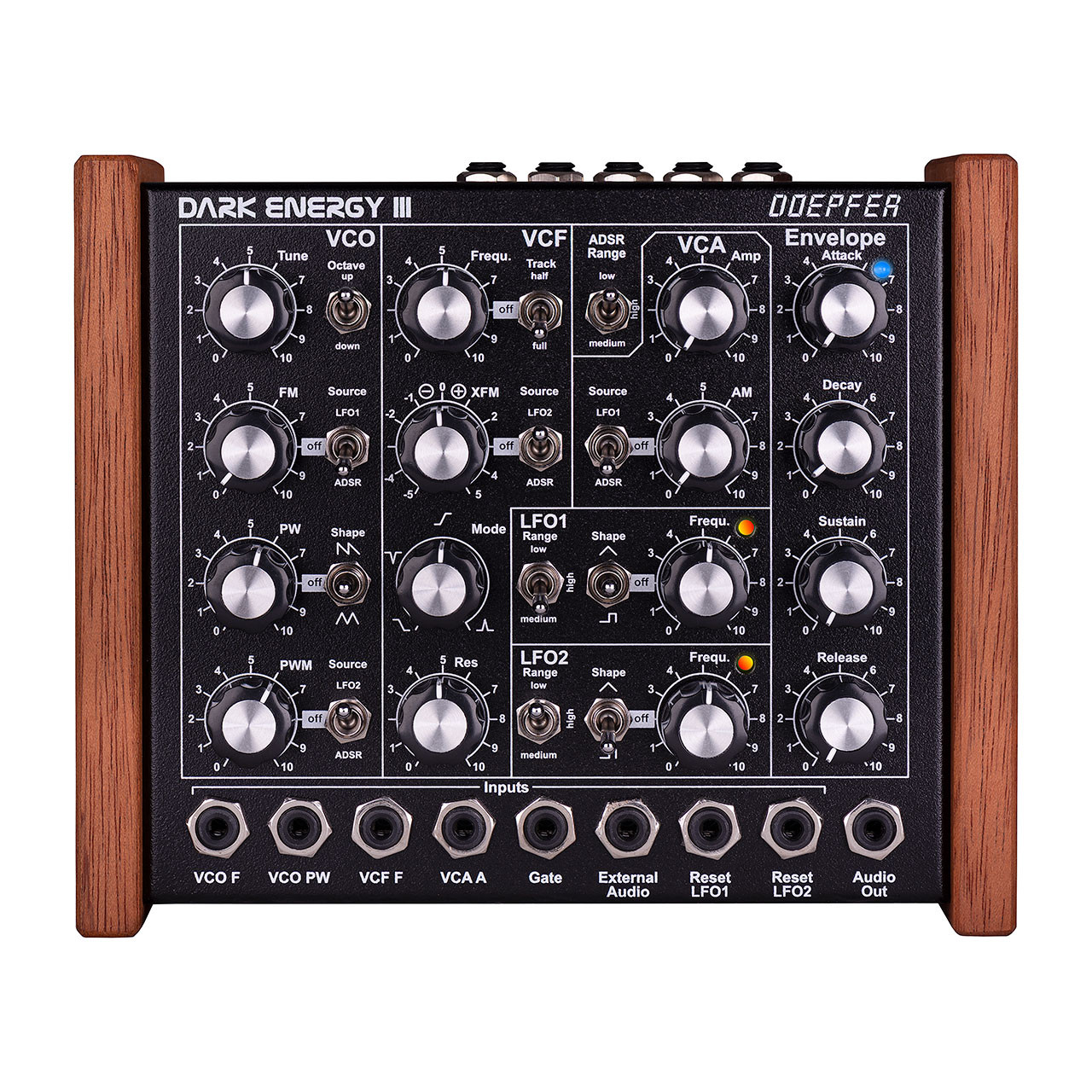
Dark Energy III is built into a rugged black metal case with wooden side plates. High quality potentiometers with metal shafts are used and each potentiometer - except the filter mode control - is fixed to the case (no wobbly shafts and knobs). The distance between the controls is a bit wider compared to A-100 modules and knobs with vintage look are used.
Dark Energy III is made of these components.
VCO
- Triangle based VCO core
- Manual tune control (with an internal jumper the range can be set to ~ +/-1 half an octave or ~ +/-2.5 octaves)
- Range switch -1 / 0 / +1 octave
- Frequency range about 32 Hz/C0 (reference note and octave switch in position -1) to about 4.2 kHz/C8 (reference note plus 5 octaves and octave switch in position +1)
- FM (frequency modulation) control with modulation source switch (LFO1 / off / ADSR)
- Manual pulsewidth control for rectangle waveform
- PWM control with modulation source switch (LFO2 / off / ADSR)
- Waveform switch (sawtooth / off / triangle)
- The sum of the waveform chosen by this switch and the rectangle is fed into the VCF (to turn the rectangle off the PW control has to be set fully CCW)
- External CV input for VCO frequency (1V/octave)
- External CV input for external PWM of the rectangle
- Internal CV input for frequency (1V/octave) connected to the CV1 output of the built-in USB/Midi interface
- No warm-up period
- 1V/octave tracking over at least 8 octaves
VCF
- 12dB multimode filter with lowpass, notch, highpass and bandpass
- Mode control for continuous transition from lowpass via notch to highpass and along to bandpass
manual frequency control - Tracking switch half - off - full (internally connected to the external frequency CV input of the VCO, i.e. the VCF tracks to the VCO if the switch is set to "half" or "full" position)
- Exponential frequency modulation control (XFM) with modulation source switch (LFO2 / off / ADSR), the XFM control has polarizer function, i.e. the modulation source (LFO2 or ADSR) selected by the Source switch may affect the filter frequency in a positive (right half of the control range) or negative way (left half of the control range)
- Manual resonance control (up to self oscillation)
- External audio input (this signal is added to the VCO signal)
- External CV input for filter frequency
- 1V/octave tracking for usage of the VCF as a sine wave oscillator over a few octaves (not as precise as the VCO and not temperature compensated, but much better than most of the other filters)
VCA
- Manual amplitude control (initial gain)
- AM (amplitude modulation) control with modulation source switch (LFO1 / off / ADSR)
- External CV input for VCA amplitude
- Linear control scale.
LFO1 and LFO2
- manual frequency control
- Waveform switch (triangle / off / rectangle)
- Range switch (low, audio, medium)
- Reset input (the rising edge of a gate/trigger/rectangle signal with at least 5V level causes to start the triangle from zero Volts with the rising edge)
- LED display (dual green/red color for positive/negative share of the signal)
- The LFO1 signal is available as an additional socket (to use the LFO1 signal for external modules)
ADSR
- Manual controls for Attack, Decay, Sustain, Release
- Range switch (long, short, medium)
- Blue LED display
- ADSR signal is available as an additional socket (to use the ADSR signal for external modules)
- External Gate input (normalled via switching contact of the socket to the Gate output of the built-in USB/Midi interface)
USB/Midi-Interface
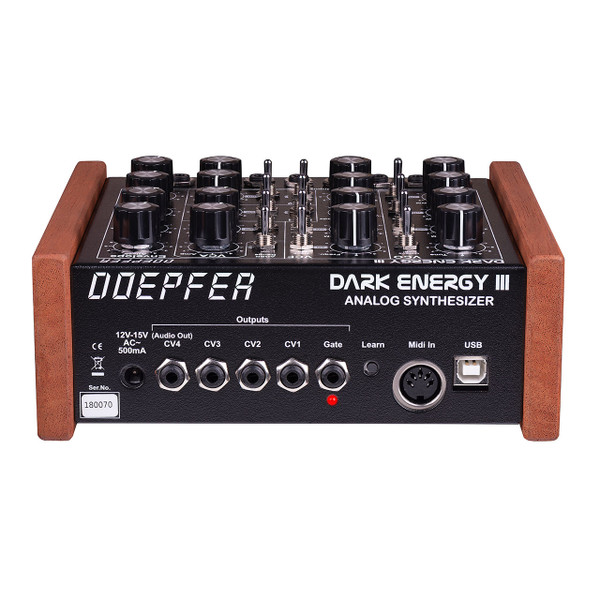
- Midi channel and reference note are adjusted by means of a learn button and LED at the rear panel
- The interface generates the gate signal that controls the envelope generator and three analog control voltages: CV1 is used to control the pitch of the VCO, CV2 the VCF frequency (free assignable Midi controller) and CV3 is available as an additional socket at the rear panel (controlled by volume/velocity). It can be patched e.g. to the VCF control input to control the filter via velocity.
- CV voltage range 0... +5V (corresponds to 5 octaves)
- The threes CVs and the gate signal are also available at the rear panel as jack sockets
- Cascading of several units via internal Midi Out/Midi In connection, because of shortage of space the unit has no Midi Out socket available this connection has to be established internally, for this the metal case has a hole on both sides so that the Midi Out/In connection can be made via this hole provided that both units are mounted to one another, the Midi Out has Midi Thru function with one exception: the signal does not include the Midi note messages that have been processed already, consequently polyphonic cascading (all daisy-chained Dark Energies on the same Midi channel) or monophonic cascading (different Midi channels) is possible, it's possible to connect only the first unit to USB and pass on the Midi data via the internal Midi link to other devices)
In/Outputs
(All monophonic 3.5 mm jack sockets, except USB, Midi and power supply)
Front panel:
- CV In VCO frequency (1V/oct)
- CV In VCO pulsewidth (about 5V range for full scale)
- CV In VCF frequency (~ 1V/oct)
- CV In VCA amplitude (0...+5V)
- Gate In (0/+5...12V)
- External Audio In (typ. 1Vss without distortion)
- Reset LFO 1
- Reset LFO 2
- Inverted LFO1 Out (~ -2.5 ... +2.5V)
- Envelope Out (~ 0 ... +6V)
- Audio Out (line output, typ. 1Vss, monophonic)
Rear panel:
- USB
- Midi In
- Learn button
- Gate Out (with LED for Gate display and learn function), 0/+5V
- CV1: controlled by Midi note messages, 1V/Oct, 0...+5V, internally connected to VCO CV input
- CV2: controlled by Midi pitch bend, ~ -2.5...+2.5V or ~ 0...+5V (can be selected by an internal jumper), no internal connection, the socket can be patched e.g. to the VCO or VCF CV input at the front panel
- CV3: controlled by Midi velocity, 0...+5V, no internal connection, the socket can be patched e.g. to the VCF input at the front panel
- CV4: controlled by Midi control change messages, free assignale controller in learn mode, no internal connection, the socket can be patched e.g. to the VCF or VCO pulsewidht input at the front panel
the CV4 socket can be used also as audio output, the function of the socket can be selected by an internal jumper, factory setting is CV4, when changed to audio output no cable at the front panel is required (unless one wants to patch something), in this case CV4 is not available - power supply (12...15V AC, min. 500mA), low voltage DC socket with 5.5 mm outer diameter and 2.1 mm inner diameter (even plugs with 2.5 mm inner diameter will work)
Internal connections
- Midi out (pin header with 2 pins for internal routing of the Midi signal to another Dark Energy)
- Midi in (pin header with 2 pins for internal routing of the Midi signal from another Dark Energy)
- By means of this internal connections several Dark Energy devices can be daisy-chained. Only the first device has to be connected to the Midi or USB transmitter. For this purpose the side plates of the metal case are equipped with holes that allow the internal connection of 2 or more Dark Energy devices. For this the metal cases have to be mounted directly to each other without wooden sideplate between the units. If a wooden side plate is desired between the devices one has to drill a hole to enable the internal connection.
- Several devices can be daisy-chained multiple monophonic (i.e. each Dark Energy received at a different Midi channel) or polyphonic (i.e. all devices are adjusted to the same Midi channel). For polyphonic applications a special stack mode is available. In this mode the device in question does not transmit note messages at the Midi output that are used to generate the tone in the device. Only "unused" note messages are transmitted.
How much is my shipping?
Shipping costs are calculated automatically at checkout. Simply add items to your cart and proceed to the checkout page, where you'll see the available shipping options and their prices. VAT at the applicable rate for your country will also be displayed at checkout.
European Union orders:
- Standard shipping is free on orders over €100. Express shipping is available on orders over €100, and free on orders over €400.
Poland orders:
- Standard shipping is free on orders over 250 PLN. Express shipping is free on orders over 500 PLN.
What about local taxes?
By default prices on the site include sales tax at 20%. The precise sales tax rate for your country will be calculated at checkout.
Do you ship to my country?
We ship to all EU member states from our warehouse in Warsaw, Poland. Add an item to your cart and enter your country and postcode to see the available shipping options and prices for your location. If you have any questions about shipping to your country, drop us an email at info@signalsounds.eu and we'll be happy to help.
Shipping methods
All EU orders are shipped via UPS. We offer two service levels:
- UPS Standard – our default shipping option. Delivery times vary by country (see estimated delivery times below).
- UPS Express Saver – next business day delivery to most EU destinations.
Each product page shows the estimated delivery time for your location, so you'll always know what to expect before you order.
Estimated delivery times (Standard shipping)
The times below are estimates in working days from dispatch, based on UPS Standard service. Express Saver delivers by the next business day to most destinations.
| Country | Estimated delivery (working days) |
|---|---|
| Austria | 2–3 |
| Belgium | 2 |
| Bulgaria | 4–5 |
| Croatia | 2–4 |
| Cyprus | 10 |
| Czechia | 2–3 |
| Denmark | 3 |
| Estonia | 2–3 |
| Finland | 3–5 |
| France | 2–4 |
| Germany | 2 |
| Greece | 5–7 |
| Hungary | 2–3 |
| Ireland | 4–6 |
| Italy | 3–5 |
| Latvia | 2–3 |
| Lithuania | 1–2 |
| Luxembourg | 2 |
| Malta | 5–7 |
| Netherlands | 2 |
| Poland | 1–2 |
| Portugal | 4–5 |
| Romania | 3–4 |
| Slovakia | 2–3 |
| Slovenia | 2–3 |
| Spain | 4 |
| Sweden | 3–5 |
These times are estimates and are not guaranteed. Delivery may occasionally take a little longer due to customs processing, local conditions, or carrier delays.
Dispatch times
Orders placed before 15:00 CET (Central European Time) on a working day are normally dispatched the same day. Orders placed after 15:00 CET, or on weekends and public holidays, will be dispatched on the next working day.
If you have an urgent order, please email us at info@signalsounds.eu before placing your order and we'll do our best to accommodate you.
Pre-orders
If a product is listed as a pre-order, it means we've ordered it from the supplier but it's not physically in stock yet. The product listing will include an estimated shipping date based on the best information we have from the supplier, but do bear in mind this is subject to change and is not a guaranteed date.
If you place an order containing a mixture of in-stock and pre-order items, we'll normally hold off on shipping anything until the pre-order item(s) have arrived, rather than splitting it into multiple shipments. If you need the in-stock items sooner, we'd recommend placing separate orders. As always, please get in touch at info@signalsounds.eu if you have questions.
Product Overview
Manufacturer's description
Dark Energy III is a monophonic stand-alone synthesizer with USB and MIDI interface. It is the follower of the successful Dark Energy I and Dark Energy II. The sound generation and all modulation sources are 100% analog, only the USB/Midi interface contains digital components.
Dark Energy III is built into a rugged black metal case with wooden side plates. High quality potentiometers with metal shafts are used and each potentiometer - except the filter mode control - is fixed to the case (no wobbly shafts and knobs). The distance between the controls is a bit wider compared to A-100 modules and knobs with vintage look are used.
Dark Energy III is made of these components.
VCO
- Triangle based VCO core
- Manual tune control (with an internal jumper the range can be set to ~ +/-1 half an octave or ~ +/-2.5 octaves)
- Range switch -1 / 0 / +1 octave
- Frequency range about 32 Hz/C0 (reference note and octave switch in position -1) to about 4.2 kHz/C8 (reference note plus 5 octaves and octave switch in position +1)
- FM (frequency modulation) control with modulation source switch (LFO1 / off / ADSR)
- Manual pulsewidth control for rectangle waveform
- PWM control with modulation source switch (LFO2 / off / ADSR)
- Waveform switch (sawtooth / off / triangle)
- The sum of the waveform chosen by this switch and the rectangle is fed into the VCF (to turn the rectangle off the PW control has to be set fully CCW)
- External CV input for VCO frequency (1V/octave)
- External CV input for external PWM of the rectangle
- Internal CV input for frequency (1V/octave) connected to the CV1 output of the built-in USB/Midi interface
- No warm-up period
- 1V/octave tracking over at least 8 octaves
VCF
- 12dB multimode filter with lowpass, notch, highpass and bandpass
- Mode control for continuous transition from lowpass via notch to highpass and along to bandpass
manual frequency control - Tracking switch half - off - full (internally connected to the external frequency CV input of the VCO, i.e. the VCF tracks to the VCO if the switch is set to "half" or "full" position)
- Exponential frequency modulation control (XFM) with modulation source switch (LFO2 / off / ADSR), the XFM control has polarizer function, i.e. the modulation source (LFO2 or ADSR) selected by the Source switch may affect the filter frequency in a positive (right half of the control range) or negative way (left half of the control range)
- Manual resonance control (up to self oscillation)
- External audio input (this signal is added to the VCO signal)
- External CV input for filter frequency
- 1V/octave tracking for usage of the VCF as a sine wave oscillator over a few octaves (not as precise as the VCO and not temperature compensated, but much better than most of the other filters)
VCA
- Manual amplitude control (initial gain)
- AM (amplitude modulation) control with modulation source switch (LFO1 / off / ADSR)
- External CV input for VCA amplitude
- Linear control scale.
LFO1 and LFO2
- manual frequency control
- Waveform switch (triangle / off / rectangle)
- Range switch (low, audio, medium)
- Reset input (the rising edge of a gate/trigger/rectangle signal with at least 5V level causes to start the triangle from zero Volts with the rising edge)
- LED display (dual green/red color for positive/negative share of the signal)
- The LFO1 signal is available as an additional socket (to use the LFO1 signal for external modules)
ADSR
- Manual controls for Attack, Decay, Sustain, Release
- Range switch (long, short, medium)
- Blue LED display
- ADSR signal is available as an additional socket (to use the ADSR signal for external modules)
- External Gate input (normalled via switching contact of the socket to the Gate output of the built-in USB/Midi interface)
USB/Midi-Interface
- Midi channel and reference note are adjusted by means of a learn button and LED at the rear panel
- The interface generates the gate signal that controls the envelope generator and three analog control voltages: CV1 is used to control the pitch of the VCO, CV2 the VCF frequency (free assignable Midi controller) and CV3 is available as an additional socket at the rear panel (controlled by volume/velocity). It can be patched e.g. to the VCF control input to control the filter via velocity.
- CV voltage range 0... +5V (corresponds to 5 octaves)
- The threes CVs and the gate signal are also available at the rear panel as jack sockets
- Cascading of several units via internal Midi Out/Midi In connection, because of shortage of space the unit has no Midi Out socket available this connection has to be established internally, for this the metal case has a hole on both sides so that the Midi Out/In connection can be made via this hole provided that both units are mounted to one another, the Midi Out has Midi Thru function with one exception: the signal does not include the Midi note messages that have been processed already, consequently polyphonic cascading (all daisy-chained Dark Energies on the same Midi channel) or monophonic cascading (different Midi channels) is possible, it's possible to connect only the first unit to USB and pass on the Midi data via the internal Midi link to other devices)
In/Outputs
(All monophonic 3.5 mm jack sockets, except USB, Midi and power supply)
Front panel:
- CV In VCO frequency (1V/oct)
- CV In VCO pulsewidth (about 5V range for full scale)
- CV In VCF frequency (~ 1V/oct)
- CV In VCA amplitude (0...+5V)
- Gate In (0/+5...12V)
- External Audio In (typ. 1Vss without distortion)
- Reset LFO 1
- Reset LFO 2
- Inverted LFO1 Out (~ -2.5 ... +2.5V)
- Envelope Out (~ 0 ... +6V)
- Audio Out (line output, typ. 1Vss, monophonic)
Rear panel:
- USB
- Midi In
- Learn button
- Gate Out (with LED for Gate display and learn function), 0/+5V
- CV1: controlled by Midi note messages, 1V/Oct, 0...+5V, internally connected to VCO CV input
- CV2: controlled by Midi pitch bend, ~ -2.5...+2.5V or ~ 0...+5V (can be selected by an internal jumper), no internal connection, the socket can be patched e.g. to the VCO or VCF CV input at the front panel
- CV3: controlled by Midi velocity, 0...+5V, no internal connection, the socket can be patched e.g. to the VCF input at the front panel
- CV4: controlled by Midi control change messages, free assignale controller in learn mode, no internal connection, the socket can be patched e.g. to the VCF or VCO pulsewidht input at the front panel
the CV4 socket can be used also as audio output, the function of the socket can be selected by an internal jumper, factory setting is CV4, when changed to audio output no cable at the front panel is required (unless one wants to patch something), in this case CV4 is not available - power supply (12...15V AC, min. 500mA), low voltage DC socket with 5.5 mm outer diameter and 2.1 mm inner diameter (even plugs with 2.5 mm inner diameter will work)
Internal connections
- Midi out (pin header with 2 pins for internal routing of the Midi signal to another Dark Energy)
- Midi in (pin header with 2 pins for internal routing of the Midi signal from another Dark Energy)
- By means of this internal connections several Dark Energy devices can be daisy-chained. Only the first device has to be connected to the Midi or USB transmitter. For this purpose the side plates of the metal case are equipped with holes that allow the internal connection of 2 or more Dark Energy devices. For this the metal cases have to be mounted directly to each other without wooden sideplate between the units. If a wooden side plate is desired between the devices one has to drill a hole to enable the internal connection.
- Several devices can be daisy-chained multiple monophonic (i.e. each Dark Energy received at a different Midi channel) or polyphonic (i.e. all devices are adjusted to the same Midi channel). For polyphonic applications a special stack mode is available. In this mode the device in question does not transmit note messages at the Midi output that are used to generate the tone in the device. Only "unused" note messages are transmitted.
Technical Specs
Shipping Details
How much is my shipping?
Shipping costs are calculated automatically at checkout. Simply add items to your cart and proceed to the checkout page, where you'll see the available shipping options and their prices. VAT at the applicable rate for your country will also be displayed at checkout.
European Union orders:
- Standard shipping is free on orders over €100. Express shipping is available on orders over €100, and free on orders over €400.
Poland orders:
- Standard shipping is free on orders over 250 PLN. Express shipping is free on orders over 500 PLN.
What about local taxes?
By default prices on the site include sales tax at 20%. The precise sales tax rate for your country will be calculated at checkout.
Do you ship to my country?
We ship to all EU member states from our warehouse in Warsaw, Poland. Add an item to your cart and enter your country and postcode to see the available shipping options and prices for your location. If you have any questions about shipping to your country, drop us an email at info@signalsounds.eu and we'll be happy to help.
Shipping methods
All EU orders are shipped via UPS. We offer two service levels:
- UPS Standard – our default shipping option. Delivery times vary by country (see estimated delivery times below).
- UPS Express Saver – next business day delivery to most EU destinations.
Each product page shows the estimated delivery time for your location, so you'll always know what to expect before you order.
Estimated delivery times (Standard shipping)
The times below are estimates in working days from dispatch, based on UPS Standard service. Express Saver delivers by the next business day to most destinations.
| Country | Estimated delivery (working days) |
|---|---|
| Austria | 2–3 |
| Belgium | 2 |
| Bulgaria | 4–5 |
| Croatia | 2–4 |
| Cyprus | 10 |
| Czechia | 2–3 |
| Denmark | 3 |
| Estonia | 2–3 |
| Finland | 3–5 |
| France | 2–4 |
| Germany | 2 |
| Greece | 5–7 |
| Hungary | 2–3 |
| Ireland | 4–6 |
| Italy | 3–5 |
| Latvia | 2–3 |
| Lithuania | 1–2 |
| Luxembourg | 2 |
| Malta | 5–7 |
| Netherlands | 2 |
| Poland | 1–2 |
| Portugal | 4–5 |
| Romania | 3–4 |
| Slovakia | 2–3 |
| Slovenia | 2–3 |
| Spain | 4 |
| Sweden | 3–5 |
These times are estimates and are not guaranteed. Delivery may occasionally take a little longer due to customs processing, local conditions, or carrier delays.
Dispatch times
Orders placed before 15:00 CET (Central European Time) on a working day are normally dispatched the same day. Orders placed after 15:00 CET, or on weekends and public holidays, will be dispatched on the next working day.
If you have an urgent order, please email us at info@signalsounds.eu before placing your order and we'll do our best to accommodate you.
Pre-orders
If a product is listed as a pre-order, it means we've ordered it from the supplier but it's not physically in stock yet. The product listing will include an estimated shipping date based on the best information we have from the supplier, but do bear in mind this is subject to change and is not a guaranteed date.
If you place an order containing a mixture of in-stock and pre-order items, we'll normally hold off on shipping anything until the pre-order item(s) have arrived, rather than splitting it into multiple shipments. If you need the in-stock items sooner, we'd recommend placing separate orders. As always, please get in touch at info@signalsounds.eu if you have questions.


