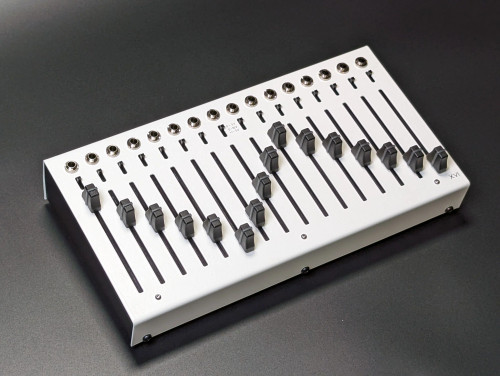


Bella is a monophonic synthesizer with an all-analog signal path, paired with a lo-fi digital drum synthesizer. These two sections are controlled by an on-board sequencer/arpeggiator, featuring generative drum pattern sequencing. It is based on the Mutable Instruments Anushri designed by Emilie Guilet.
Bella’s audio generation and processing chain is analog. The main sound source is a VCO with sawtooth and pulse-width waveforms, coupled with a sub-oscillator. Following the VCO comes a multimode 12dB/octave VCF featuring low-pass, band-pass and high-pass modes. A switchable fuzz circuit is inserted between the VCF and VCA for a heavy dose of distortion.
Digital additions:
VCO is paired with an auxiliary digital oscillator, which can be used as a FM source, a sync signal generator, or an additional detuned audio source for fattening the VCO sound.
Built-in sequencer and arpeggiator
A built-in arpeggiator easily transforms chords into complex basslines and acid patterns with accent and slides. But the real fun starts when you use the built-in sequencer. Its interface is refreshingly simple: press rec, input notes on the MIDI keyboard or press the rest/tie buttons, press rec to finish, then start. The sequence can even be transposed from the keyboard.
Built-in drum machine
Anushri comes with a truly original rhythmic section. Original in sound, using 8-bit analog-style synthesis with integrated bit-crusher. Original in interface, since it is “programmed”, or rather sculpted with knobs rather than x0x style switches and LEDs. 2 knobs control morphing through different structures of drum patterns, and 3 knobs control how sparse/dense the pattern is for bass drum/snare drum/hi-hat, allowing you to create fills and variations at the twist of a knob. This was scheme developed into the Grids module.
Specifications:
Control: MIDI or CV/Gate
VCO
Discrete Analog
Controls:
FM controls by which amount the DCO signal modulates the frequency of the VCO. This modulation is linear FM. Dissonant and metallic timbres can be achieved by setting FM to a high value, and by detuning the DCO and VCO with the VCO range or VCO detune knobs.
VCO mod controls which modulation is applied to the VCO. In central position (the potentiometer has a detent at 12 o'clock), no modulation is applied to the VCO. When turning the knob clockwise, an increasing amount of LFO modulation is applied. When turning the knob counter-clockwise, an increasing amount of AD envelope modulation is applied
PW adjusts the pulse-width of the square waveform. In central position (the potentiometer has a detent at 12 o'clock), the output signal is a square waveform.
PW mod controls the modulation applied to pulse-width. In central position (the potentiometer has a detent at 12 o'clock), no modulation is applied to the pulse width. When turning the knob clockwise, an increasing amount of LFO modulation is applied. When turning the knob counter-clockwise, an increasing amount of AD envelope modulation is applied.
Sync resets the cycle of the VCO every time the DCO completes a full cycle. This works particularly well when the VCO is set to a higher pitch than the DCO (high value of the VCO range pot), and when an envelope or LFO modulation is applied to the VCO.
Glide adjusts the portamento time between consecutive notes. This causes the pitch of the previous note to slowly slide towards the pitch of the next note.
VCO range adjusts the pitch of the VCO relatively to the note played on the keyboard, from -12 semitones to +36 semitones. This potentiometer is deliberately "steppy", with one step for each semitones, and a dead-band at octaves (-12, 0, 12, 24, 36 semitones).
VCO detune adjusts the VCO pitch on a fine scale, to create a slight detuning effect between the VCO and the DCO.
Mix controls the balance of the sawtooth and square waveshapers. In center position, both waveshapes are mixed together. Fully turned clock-wise, only the square wave can be heard. Fully turned counter-clock-wise, only the sawtooth wave can be heard.
Sub level controls the level of an additional signal added to the mix. This signal is selected with the Sub switch, from one of these 3 sources:
VCF
Discrete Analog
12dB/Octave Multimode
Low-pass, High-pass, Bandpass
Cutoff Frequency 18 Hz to 22kHz
Filter Tracks note pitch
Controls:
Resonance adjusts the filter resonance, progressively emphasizing the frequencies in the vicinity of the cutoff frequency.
VCF env mod controls the amount of ADSR1 modulation applied to filter cutoff.
VCF LFO mod controls the amount of LFO modulation applied to filter cutoff.
VCF mode selects the filter mode: low-pass, band-pass, or high-pass.
LFO
Controls:
LFO shape selects the waveform of the main LFO. The following shapes are available:
- Triangle.
- Square.
- Ramp up.
- Ramp down.
- Sample and hold. The LFO periodically takes a random value.
- Bernouilli process. The LFO randomly switches between a high and low value. The rate of transition is affected by the rate parameter.
- Smooth random process. A continuous random waveform made of lines with a randomly selected slope is generated. The higher the rate, the higher the digital manic pixie dream cat tweaks the knobs.
- Noise. The LFO output is a white noise signal. In this case, the rate parameter of the LFO has no effect.
LFO rate adjusts the speed of the LFO. The LFO frequency ranges from 0.06 Hz (a full cycle takes 16s) to 100 Hz. Note that when the rate setting is set to its minimum value, the LFO locks itself to the sequencer/arpeggiator clock, so that the LFO accomplishes a full cycle over a period of 4 beats. This synchronization is achieved through a PLL - it might take a few beats before the LFO effectively locks to the sequence.
Jacks
Gate In: 3.5mm TS
Sequencer Gate Out: 5V 3.5mm TS
Clock In (Sequencer): 3.5mm TS
Sequencer Clock Out: 5V 3.5mm TS
VCO CV In: V/Oct 3.5mm TS
PW CV In: 3.5mm TS
VCF CV In: V/Oct 3.5mm TS
VCA CV In: Additional Modulation of VCA, 3.5mm TS
Aux Audio In: External Signal Processing, 3.5mm TS
Drums Audio Out: Removes Drums from main Mix, 3.5mm TS
Main Out: Drums+Synth Mix, 3.5mm TS
MIDI In: TRS MIDI A or B, 3.5mm TRS
MIDI Out: TRS MIDI A, 3.5mm TRS
Please note, no power supply is included with this product.
Power
9V DC, 500 mA, Tip positive. 120-240V Included
Dimensions
13"x2.5"x8"
How much is my shipping?
Shipping costs are calculated automatically at checkout. Simply add items to your cart and proceed to the checkout page, where you'll see the available shipping options and their prices. VAT at the applicable rate for your country will also be displayed at checkout.
European Union orders:
- Standard shipping is free on orders over €100. Express shipping is available on orders over €100, and free on orders over €400.
- Free deliveryn and express delivery are not available to islands and remote areas including but not limited to Cyprus, Malta, Ceuta and more throughout the European Union. Add products to your cart and enter your address to confirm yoru shipping charge.
Poland orders:
- Standard shipping is free on orders over 250 PLN. Express shipping is free on orders over 500 PLN.
What about local taxes?
By default prices on the site include sales tax at 20%. The precise sales tax rate for your country will be calculated at checkout.
Do you ship to my country?
We ship to all EU member states from our warehouse in Warsaw, Poland. Add an item to your cart and enter your country and postcode to see the available shipping options and prices for your location. If you have any questions about shipping to your country, drop us an email at info@signalsounds.eu and we'll be happy to help.
Shipping methods
All EU orders are shipped via UPS. We offer two service levels:
- UPS Standard – our default shipping option. Delivery times vary by country (see estimated delivery times below).
- UPS Express Saver – next business day delivery to most EU destinations.
Each product page shows the estimated delivery time for your location, so you'll always know what to expect before you order.
Estimated delivery times (Standard shipping)
The times below are estimates in working days from dispatch, based on UPS Standard service. Express Saver delivers by the next business day to most destinations.
| Country | Estimated delivery (working days) |
|---|---|
| Austria | 2–3 |
| Belgium | 2 |
| Bulgaria | 4–5 |
| Croatia | 2–4 |
| Cyprus | 10 |
| Czechia | 2–3 |
| Denmark | 3 |
| Estonia | 2–3 |
| Finland | 3–5 |
| France | 2–4 |
| Germany | 2 |
| Greece | 5–7 |
| Hungary | 2–3 |
| Ireland | 4–6 |
| Italy | 3–5 |
| Latvia | 2–3 |
| Lithuania | 1–2 |
| Luxembourg | 2 |
| Malta | 5–7 |
| Netherlands | 2 |
| Poland | 1–2 |
| Portugal | 4–5 |
| Romania | 3–4 |
| Slovakia | 2–3 |
| Slovenia | 2–3 |
| Spain | 4 |
| Sweden | 3–5 |
These times are estimates and are not guaranteed. Delivery may occasionally take a little longer due to customs processing, local conditions, or carrier delays.
Dispatch times
Orders placed before 15:00 CET (Central European Time) on a working day are normally dispatched the same day. Orders placed after 15:00 CET, or on weekends and public holidays, will be dispatched on the next working day.
If you have an urgent order, please email us at info@signalsounds.eu before placing your order and we'll do our best to accommodate you.
Pre-orders
If a product is listed as a pre-order, it means we've ordered it from the supplier but it's not physically in stock yet. The product listing will include an estimated shipping date based on the best information we have from the supplier, but do bear in mind this is subject to change and is not a guaranteed date.
If you place an order containing a mixture of in-stock and pre-order items, we'll normally hold off on shipping anything until the pre-order item(s) have arrived, rather than splitting it into multiple shipments. If you need the in-stock items sooner, we'd recommend placing separate orders. As always, please get in touch at info@signalsounds.eu if you have questions.
Product Overview
Bella is a monophonic synthesizer with an all-analog signal path, paired with a lo-fi digital drum synthesizer. These two sections are controlled by an on-board sequencer/arpeggiator, featuring generative drum pattern sequencing. It is based on the Mutable Instruments Anushri designed by Emilie Guilet.
Bella’s audio generation and processing chain is analog. The main sound source is a VCO with sawtooth and pulse-width waveforms, coupled with a sub-oscillator. Following the VCO comes a multimode 12dB/octave VCF featuring low-pass, band-pass and high-pass modes. A switchable fuzz circuit is inserted between the VCF and VCA for a heavy dose of distortion.
Digital additions:
VCO is paired with an auxiliary digital oscillator, which can be used as a FM source, a sync signal generator, or an additional detuned audio source for fattening the VCO sound.
Built-in sequencer and arpeggiator
A built-in arpeggiator easily transforms chords into complex basslines and acid patterns with accent and slides. But the real fun starts when you use the built-in sequencer. Its interface is refreshingly simple: press rec, input notes on the MIDI keyboard or press the rest/tie buttons, press rec to finish, then start. The sequence can even be transposed from the keyboard.
Built-in drum machine
Anushri comes with a truly original rhythmic section. Original in sound, using 8-bit analog-style synthesis with integrated bit-crusher. Original in interface, since it is “programmed”, or rather sculpted with knobs rather than x0x style switches and LEDs. 2 knobs control morphing through different structures of drum patterns, and 3 knobs control how sparse/dense the pattern is for bass drum/snare drum/hi-hat, allowing you to create fills and variations at the twist of a knob. This was scheme developed into the Grids module.
Specifications:
Control: MIDI or CV/Gate
VCO
Discrete Analog
Controls:
FM controls by which amount the DCO signal modulates the frequency of the VCO. This modulation is linear FM. Dissonant and metallic timbres can be achieved by setting FM to a high value, and by detuning the DCO and VCO with the VCO range or VCO detune knobs.
VCO mod controls which modulation is applied to the VCO. In central position (the potentiometer has a detent at 12 o'clock), no modulation is applied to the VCO. When turning the knob clockwise, an increasing amount of LFO modulation is applied. When turning the knob counter-clockwise, an increasing amount of AD envelope modulation is applied
PW adjusts the pulse-width of the square waveform. In central position (the potentiometer has a detent at 12 o'clock), the output signal is a square waveform.
PW mod controls the modulation applied to pulse-width. In central position (the potentiometer has a detent at 12 o'clock), no modulation is applied to the pulse width. When turning the knob clockwise, an increasing amount of LFO modulation is applied. When turning the knob counter-clockwise, an increasing amount of AD envelope modulation is applied.
Sync resets the cycle of the VCO every time the DCO completes a full cycle. This works particularly well when the VCO is set to a higher pitch than the DCO (high value of the VCO range pot), and when an envelope or LFO modulation is applied to the VCO.
Glide adjusts the portamento time between consecutive notes. This causes the pitch of the previous note to slowly slide towards the pitch of the next note.
VCO range adjusts the pitch of the VCO relatively to the note played on the keyboard, from -12 semitones to +36 semitones. This potentiometer is deliberately "steppy", with one step for each semitones, and a dead-band at octaves (-12, 0, 12, 24, 36 semitones).
VCO detune adjusts the VCO pitch on a fine scale, to create a slight detuning effect between the VCO and the DCO.
Mix controls the balance of the sawtooth and square waveshapers. In center position, both waveshapes are mixed together. Fully turned clock-wise, only the square wave can be heard. Fully turned counter-clock-wise, only the sawtooth wave can be heard.
Sub level controls the level of an additional signal added to the mix. This signal is selected with the Sub switch, from one of these 3 sources:
VCF
Discrete Analog
12dB/Octave Multimode
Low-pass, High-pass, Bandpass
Cutoff Frequency 18 Hz to 22kHz
Filter Tracks note pitch
Controls:
Resonance adjusts the filter resonance, progressively emphasizing the frequencies in the vicinity of the cutoff frequency.
VCF env mod controls the amount of ADSR1 modulation applied to filter cutoff.
VCF LFO mod controls the amount of LFO modulation applied to filter cutoff.
VCF mode selects the filter mode: low-pass, band-pass, or high-pass.
LFO
Controls:
LFO shape selects the waveform of the main LFO. The following shapes are available:
- Triangle.
- Square.
- Ramp up.
- Ramp down.
- Sample and hold. The LFO periodically takes a random value.
- Bernouilli process. The LFO randomly switches between a high and low value. The rate of transition is affected by the rate parameter.
- Smooth random process. A continuous random waveform made of lines with a randomly selected slope is generated. The higher the rate, the higher the digital manic pixie dream cat tweaks the knobs.
- Noise. The LFO output is a white noise signal. In this case, the rate parameter of the LFO has no effect.
LFO rate adjusts the speed of the LFO. The LFO frequency ranges from 0.06 Hz (a full cycle takes 16s) to 100 Hz. Note that when the rate setting is set to its minimum value, the LFO locks itself to the sequencer/arpeggiator clock, so that the LFO accomplishes a full cycle over a period of 4 beats. This synchronization is achieved through a PLL - it might take a few beats before the LFO effectively locks to the sequence.
Jacks
Gate In: 3.5mm TS
Sequencer Gate Out: 5V 3.5mm TS
Clock In (Sequencer): 3.5mm TS
Sequencer Clock Out: 5V 3.5mm TS
VCO CV In: V/Oct 3.5mm TS
PW CV In: 3.5mm TS
VCF CV In: V/Oct 3.5mm TS
VCA CV In: Additional Modulation of VCA, 3.5mm TS
Aux Audio In: External Signal Processing, 3.5mm TS
Drums Audio Out: Removes Drums from main Mix, 3.5mm TS
Main Out: Drums+Synth Mix, 3.5mm TS
MIDI In: TRS MIDI A or B, 3.5mm TRS
MIDI Out: TRS MIDI A, 3.5mm TRS
Please note, no power supply is included with this product.
Technical Specs
Shipping Details
How much is my shipping?
Shipping costs are calculated automatically at checkout. Simply add items to your cart and proceed to the checkout page, where you'll see the available shipping options and their prices. VAT at the applicable rate for your country will also be displayed at checkout.
European Union orders:
- Standard shipping is free on orders over €100. Express shipping is available on orders over €100, and free on orders over €400.
- Free deliveryn and express delivery are not available to islands and remote areas including but not limited to Cyprus, Malta, Ceuta and more throughout the European Union. Add products to your cart and enter your address to confirm yoru shipping charge.
Poland orders:
- Standard shipping is free on orders over 250 PLN. Express shipping is free on orders over 500 PLN.
What about local taxes?
By default prices on the site include sales tax at 20%. The precise sales tax rate for your country will be calculated at checkout.
Do you ship to my country?
We ship to all EU member states from our warehouse in Warsaw, Poland. Add an item to your cart and enter your country and postcode to see the available shipping options and prices for your location. If you have any questions about shipping to your country, drop us an email at info@signalsounds.eu and we'll be happy to help.
Shipping methods
All EU orders are shipped via UPS. We offer two service levels:
- UPS Standard – our default shipping option. Delivery times vary by country (see estimated delivery times below).
- UPS Express Saver – next business day delivery to most EU destinations.
Each product page shows the estimated delivery time for your location, so you'll always know what to expect before you order.
Estimated delivery times (Standard shipping)
The times below are estimates in working days from dispatch, based on UPS Standard service. Express Saver delivers by the next business day to most destinations.
| Country | Estimated delivery (working days) |
|---|---|
| Austria | 2–3 |
| Belgium | 2 |
| Bulgaria | 4–5 |
| Croatia | 2–4 |
| Cyprus | 10 |
| Czechia | 2–3 |
| Denmark | 3 |
| Estonia | 2–3 |
| Finland | 3–5 |
| France | 2–4 |
| Germany | 2 |
| Greece | 5–7 |
| Hungary | 2–3 |
| Ireland | 4–6 |
| Italy | 3–5 |
| Latvia | 2–3 |
| Lithuania | 1–2 |
| Luxembourg | 2 |
| Malta | 5–7 |
| Netherlands | 2 |
| Poland | 1–2 |
| Portugal | 4–5 |
| Romania | 3–4 |
| Slovakia | 2–3 |
| Slovenia | 2–3 |
| Spain | 4 |
| Sweden | 3–5 |
These times are estimates and are not guaranteed. Delivery may occasionally take a little longer due to customs processing, local conditions, or carrier delays.
Dispatch times
Orders placed before 15:00 CET (Central European Time) on a working day are normally dispatched the same day. Orders placed after 15:00 CET, or on weekends and public holidays, will be dispatched on the next working day.
If you have an urgent order, please email us at info@signalsounds.eu before placing your order and we'll do our best to accommodate you.
Pre-orders
If a product is listed as a pre-order, it means we've ordered it from the supplier but it's not physically in stock yet. The product listing will include an estimated shipping date based on the best information we have from the supplier, but do bear in mind this is subject to change and is not a guaranteed date.
If you place an order containing a mixture of in-stock and pre-order items, we'll normally hold off on shipping anything until the pre-order item(s) have arrived, rather than splitting it into multiple shipments. If you need the in-stock items sooner, we'd recommend placing separate orders. As always, please get in touch at info@signalsounds.eu if you have questions.