

Manufacturer's description
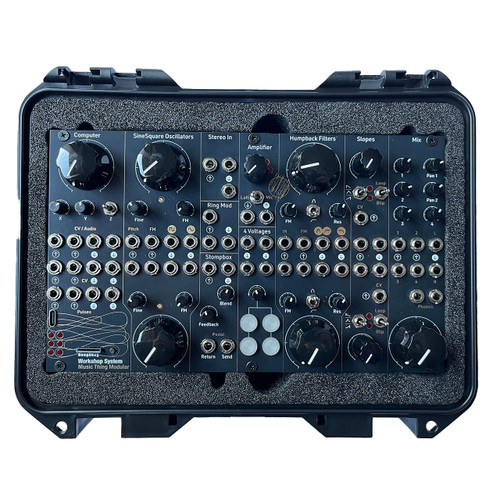
The Music Thing Modular Workshop System is a complete modular synth. It is slightly smaller than a hardback book. It comes in a foam-lined hard case.
What is the Workshop System?
The Workshop System is an analogue modular synth and a powerful audio computer – designed to be useful and open:
- A genre-neutral toolkit, a little box of ways to make and manipulate music and sound.
- A patchable, hackable, code-able modular synth that can be used in many different ways.
- A system that works with things you already have. Plug in your phone, a drum machine, a laptop, guitar pedals or a microphone.
- A computer that uses tiny proprietary program cards that are completely hackable. Anyone who writes code can make, share, sell their creations — sequencers, effects, interfaces.
The Workshop System arrives as a DIY kit which will take a few hours to put together. All the tiny SMD components have already been soldered for you, so the build process consists mainly of soldering jack sockets, potentiometers and switches while following the build guide: musicthing.co.uk/Workshop_System_Build_Guide
The Workshop System kit includes:
- All hardware required to build the Workshop System (PCBs, Front & Back Panel, components, knobs, buttons etc.)
- A rugged hard plastic carry case for easy portability with internal foam cutout to keep the system protected
- 2 x audio adaptor cables to plug a guitar pedal into the Stompbox section of the Workshop System – the cables are 3.5mm (1/8″) Minijack to 6.35mm (1/4″) Jack
- A 20cm DC barrel cable for directly powering a guitar pedal from the front of the Workshop – 9V (centre-negative)
- A keyring and set of 4 x Program Cards to get started using the computer section. The included cards are: a Turing Machine (random looping sequencer), a lush digital Reverb, a MIDI to CV converter and a Blank 2mb card to fill with another function of your choice – or to explore creating programmes of your own. More blank cards can be found HERE. These are NOT regular SD cards, but a proprietary design. Program Card colours will vary and may differ from photographs.
The kit does not include as standard (optional extras):
- Eurorack patch cables – we figure that many users of modular synths already have patch cables lying around.
- A power cable – The Workshop System has two power options: The easiest way is via USB-C PD power, but you can also use a regular 15-25v DC barrel connection. The system will happily run from battery powerbanks and laptop adaptors.
If you prefer to source your own USB-C wallwart then we recommend using one that’s rated at 30W or above. The following models have been tested as suitable with the Workshop System: UGREEN 30W | Anker Nano 30W | Anker GaN 30W | UGREEN 45W | BIUBOTY 45W | CSHARE 30W | IKEA SJÖSS
The Workshop System has 14 modules:
- 2 x SineSquare Oscillators Simple vintage-style oscillators made of 1970s tech.
- 2 x Humpback Filters Similarly vintage-style filters, designed by Philip Goulding of God’s Box.
- 2 x Slopes These work as attack/decay envelopes, LFOs and portamento generators.
- Computer Is a multi-function module with knobs, a switch and audio, CV and pulse ins and outs. Initially, the system comes with a USB MIDI card, a Turing Machine sequencer and a Reverb card. A community of programmers are creating more cards.
- Stereo In takes a 3.5mm stereo input and boosts it to modular level.
- Ring Mod is a great-sounding ring modulator, connected to the two sines. It also works as a simple VCA.
- Stompbox is an interface for guitar pedals, with blend and feedback controls to make boring pedals more interesting. There’s a 9v power outlet for pedals below this module.
- Amplifier contains two simple circuits. One is connected to a piezo contact mic behind the panel, the other is the transistor-based input circuit from a MiniMoog. In other words, a Mikrophonie and a Mini Drive.
- 4 Voltages is a minimum viable keyboard: four voltage outputs, one knob, four pushbuttons. More fun to play with than to explain.
- Mix a simple output mixer, with two stereo channels, two mono channels and a powerful headphone amp / line out.
- PSU behind the panel is a power supply that runs on USB-C PD power or professional 15-25v barrel connectors. It works from battery powerbanks and laptop adaptors, most likely something you’ve already got at home.
Workshop System FAQ
- Does it come with the case? Yes
- Can I take it out of the case? Yes
- Does it need patch cables to work? Yes, it makes no sound at all before being patched.
- How hard is it to build? All the active components (chips, transistors, resistors etc) are already installed. The Thonk Kit contains four PCBs that need to be populated with Pots, Switches, LEDs, power headers and sockets. Then all the hardware — nuts, knobs, spacers – needs to be installed. It’s fairly time consuming, maybe 1-4 hours, but not difficult for anyone who has soldered a few kits before. If you made a Mikrophonie or 8mu and enjoyed the process, you will enjoy this. If you’ve made a Turing Machine, you’re almost over-qualified. If you’ve never soldered anything before, this probably isn’t the best way to start. Instead, look out for a build workshop, or get in touch if you’d like to organise one.
- Is it Eurorack compatible? Yes, you can remove the back panel PSU and put it in a Euro case – 42hp, around 250mA current draw.
- How do the program cards work? The microcontroller in Computer is an RP2040, the same as a Raspberry Pi Pico. The program cards are the entire flash memory for the Computer, so there is no firmware on the device itself. They can be programmed in C/C++ (Pico SDK), Arduino Pico, Circuit Python or anything else that works on RP2040. Program cards can be re-programmed or updated over USB with a simple drag-and-drop process. You’re welcome to sell or give away any code you create, and can make your own custom cards if you want.
- Is there any normalisation? There is minimal normalisation built in – the two oscillators cross-modulate, and are patched to the Ring Mod, and the top filter High/Band Pass flows into the bottom filter input. So you need a lot of patch cables. However, all the normalisation points are clearly marked on the back of the PCBs, so it’s easy to add your own (removable) normalisation connections with wire and solder.
Useful Links: Quick Start Guide | Computer Guide | Build Guide | Build Video | Calibration Guide | Talking Workshop with Mylar Melodies | Workshop System Newsletter | Workshop Discord | Workshop at musicthing.co.uk


How much is my shipping?
Shipping costs are calculated automatically at checkout. Simply add items to your cart and proceed to the checkout page, where you'll see the available shipping options and their prices. VAT at the applicable rate for your country will also be displayed at checkout.
European Union orders:
- Standard shipping is free on orders over €100. Express shipping is available on orders over €100, and free on orders over €400.
- Free deliveryn and express delivery are not available to islands and remote areas including but not limited to Cyprus, Malta, Ceuta and more throughout the European Union. Add products to your cart and enter your address to confirm yoru shipping charge.
Poland orders:
- Standard shipping is free on orders over 250 PLN. Express shipping is free on orders over 500 PLN.
What about local taxes?
By default prices on the site include sales tax at 20%. The precise sales tax rate for your country will be calculated at checkout.
Do you ship to my country?
We ship to all EU member states from our warehouse in Warsaw, Poland. Add an item to your cart and enter your country and postcode to see the available shipping options and prices for your location. If you have any questions about shipping to your country, drop us an email at info@signalsounds.eu and we'll be happy to help.
Shipping methods
All EU orders are shipped via UPS. We offer two service levels:
- UPS Standard – our default shipping option. Delivery times vary by country (see estimated delivery times below).
- UPS Express Saver – next business day delivery to most EU destinations.
Each product page shows the estimated delivery time for your location, so you'll always know what to expect before you order.
Estimated delivery times (Standard shipping)
The times below are estimates in working days from dispatch, based on UPS Standard service. Express Saver delivers by the next business day to most destinations.
| Country | Estimated delivery (working days) |
|---|---|
| Austria | 2–3 |
| Belgium | 2 |
| Bulgaria | 4–5 |
| Croatia | 2–4 |
| Cyprus | 10 |
| Czechia | 2–3 |
| Denmark | 3 |
| Estonia | 2–3 |
| Finland | 3–5 |
| France | 2–4 |
| Germany | 2 |
| Greece | 5–7 |
| Hungary | 2–3 |
| Ireland | 4–6 |
| Italy | 3–5 |
| Latvia | 2–3 |
| Lithuania | 1–2 |
| Luxembourg | 2 |
| Malta | 5–7 |
| Netherlands | 2 |
| Poland | 1–2 |
| Portugal | 4–5 |
| Romania | 3–4 |
| Slovakia | 2–3 |
| Slovenia | 2–3 |
| Spain | 4 |
| Sweden | 3–5 |
These times are estimates and are not guaranteed. Delivery may occasionally take a little longer due to customs processing, local conditions, or carrier delays.
Dispatch times
Orders placed before 15:00 CET (Central European Time) on a working day are normally dispatched the same day. Orders placed after 15:00 CET, or on weekends and public holidays, will be dispatched on the next working day.
If you have an urgent order, please email us at info@signalsounds.eu before placing your order and we'll do our best to accommodate you.
Pre-orders
If a product is listed as a pre-order, it means we've ordered it from the supplier but it's not physically in stock yet. The product listing will include an estimated shipping date based on the best information we have from the supplier, but do bear in mind this is subject to change and is not a guaranteed date.
If you place an order containing a mixture of in-stock and pre-order items, we'll normally hold off on shipping anything until the pre-order item(s) have arrived, rather than splitting it into multiple shipments. If you need the in-stock items sooner, we'd recommend placing separate orders. As always, please get in touch at info@signalsounds.eu if you have questions.
Product Overview
Manufacturer's description
The Music Thing Modular Workshop System is a complete modular synth. It is slightly smaller than a hardback book. It comes in a foam-lined hard case.
What is the Workshop System?
The Workshop System is an analogue modular synth and a powerful audio computer – designed to be useful and open:
- A genre-neutral toolkit, a little box of ways to make and manipulate music and sound.
- A patchable, hackable, code-able modular synth that can be used in many different ways.
- A system that works with things you already have. Plug in your phone, a drum machine, a laptop, guitar pedals or a microphone.
- A computer that uses tiny proprietary program cards that are completely hackable. Anyone who writes code can make, share, sell their creations — sequencers, effects, interfaces.
The Workshop System arrives as a DIY kit which will take a few hours to put together. All the tiny SMD components have already been soldered for you, so the build process consists mainly of soldering jack sockets, potentiometers and switches while following the build guide: musicthing.co.uk/Workshop_System_Build_Guide
The Workshop System kit includes:
- All hardware required to build the Workshop System (PCBs, Front & Back Panel, components, knobs, buttons etc.)
- A rugged hard plastic carry case for easy portability with internal foam cutout to keep the system protected
- 2 x audio adaptor cables to plug a guitar pedal into the Stompbox section of the Workshop System – the cables are 3.5mm (1/8″) Minijack to 6.35mm (1/4″) Jack
- A 20cm DC barrel cable for directly powering a guitar pedal from the front of the Workshop – 9V (centre-negative)
- A keyring and set of 4 x Program Cards to get started using the computer section. The included cards are: a Turing Machine (random looping sequencer), a lush digital Reverb, a MIDI to CV converter and a Blank 2mb card to fill with another function of your choice – or to explore creating programmes of your own. More blank cards can be found HERE. These are NOT regular SD cards, but a proprietary design. Program Card colours will vary and may differ from photographs.
The kit does not include as standard (optional extras):
- Eurorack patch cables – we figure that many users of modular synths already have patch cables lying around.
- A power cable – The Workshop System has two power options: The easiest way is via USB-C PD power, but you can also use a regular 15-25v DC barrel connection. The system will happily run from battery powerbanks and laptop adaptors.
If you prefer to source your own USB-C wallwart then we recommend using one that’s rated at 30W or above. The following models have been tested as suitable with the Workshop System: UGREEN 30W | Anker Nano 30W | Anker GaN 30W | UGREEN 45W | BIUBOTY 45W | CSHARE 30W | IKEA SJÖSS
The Workshop System has 14 modules:
- 2 x SineSquare Oscillators Simple vintage-style oscillators made of 1970s tech.
- 2 x Humpback Filters Similarly vintage-style filters, designed by Philip Goulding of God’s Box.
- 2 x Slopes These work as attack/decay envelopes, LFOs and portamento generators.
- Computer Is a multi-function module with knobs, a switch and audio, CV and pulse ins and outs. Initially, the system comes with a USB MIDI card, a Turing Machine sequencer and a Reverb card. A community of programmers are creating more cards.
- Stereo In takes a 3.5mm stereo input and boosts it to modular level.
- Ring Mod is a great-sounding ring modulator, connected to the two sines. It also works as a simple VCA.
- Stompbox is an interface for guitar pedals, with blend and feedback controls to make boring pedals more interesting. There’s a 9v power outlet for pedals below this module.
- Amplifier contains two simple circuits. One is connected to a piezo contact mic behind the panel, the other is the transistor-based input circuit from a MiniMoog. In other words, a Mikrophonie and a Mini Drive.
- 4 Voltages is a minimum viable keyboard: four voltage outputs, one knob, four pushbuttons. More fun to play with than to explain.
- Mix a simple output mixer, with two stereo channels, two mono channels and a powerful headphone amp / line out.
- PSU behind the panel is a power supply that runs on USB-C PD power or professional 15-25v barrel connectors. It works from battery powerbanks and laptop adaptors, most likely something you’ve already got at home.
Workshop System FAQ
- Does it come with the case? Yes
- Can I take it out of the case? Yes
- Does it need patch cables to work? Yes, it makes no sound at all before being patched.
- How hard is it to build? All the active components (chips, transistors, resistors etc) are already installed. The Thonk Kit contains four PCBs that need to be populated with Pots, Switches, LEDs, power headers and sockets. Then all the hardware — nuts, knobs, spacers – needs to be installed. It’s fairly time consuming, maybe 1-4 hours, but not difficult for anyone who has soldered a few kits before. If you made a Mikrophonie or 8mu and enjoyed the process, you will enjoy this. If you’ve made a Turing Machine, you’re almost over-qualified. If you’ve never soldered anything before, this probably isn’t the best way to start. Instead, look out for a build workshop, or get in touch if you’d like to organise one.
- Is it Eurorack compatible? Yes, you can remove the back panel PSU and put it in a Euro case – 42hp, around 250mA current draw.
- How do the program cards work? The microcontroller in Computer is an RP2040, the same as a Raspberry Pi Pico. The program cards are the entire flash memory for the Computer, so there is no firmware on the device itself. They can be programmed in C/C++ (Pico SDK), Arduino Pico, Circuit Python or anything else that works on RP2040. Program cards can be re-programmed or updated over USB with a simple drag-and-drop process. You’re welcome to sell or give away any code you create, and can make your own custom cards if you want.
- Is there any normalisation? There is minimal normalisation built in – the two oscillators cross-modulate, and are patched to the Ring Mod, and the top filter High/Band Pass flows into the bottom filter input. So you need a lot of patch cables. However, all the normalisation points are clearly marked on the back of the PCBs, so it’s easy to add your own (removable) normalisation connections with wire and solder.
Useful Links: Quick Start Guide | Computer Guide | Build Guide | Build Video | Calibration Guide | Talking Workshop with Mylar Melodies | Workshop System Newsletter | Workshop Discord | Workshop at musicthing.co.uk
Technical Specs
Shipping Details
How much is my shipping?
Shipping costs are calculated automatically at checkout. Simply add items to your cart and proceed to the checkout page, where you'll see the available shipping options and their prices. VAT at the applicable rate for your country will also be displayed at checkout.
European Union orders:
- Standard shipping is free on orders over €100. Express shipping is available on orders over €100, and free on orders over €400.
- Free deliveryn and express delivery are not available to islands and remote areas including but not limited to Cyprus, Malta, Ceuta and more throughout the European Union. Add products to your cart and enter your address to confirm yoru shipping charge.
Poland orders:
- Standard shipping is free on orders over 250 PLN. Express shipping is free on orders over 500 PLN.
What about local taxes?
By default prices on the site include sales tax at 20%. The precise sales tax rate for your country will be calculated at checkout.
Do you ship to my country?
We ship to all EU member states from our warehouse in Warsaw, Poland. Add an item to your cart and enter your country and postcode to see the available shipping options and prices for your location. If you have any questions about shipping to your country, drop us an email at info@signalsounds.eu and we'll be happy to help.
Shipping methods
All EU orders are shipped via UPS. We offer two service levels:
- UPS Standard – our default shipping option. Delivery times vary by country (see estimated delivery times below).
- UPS Express Saver – next business day delivery to most EU destinations.
Each product page shows the estimated delivery time for your location, so you'll always know what to expect before you order.
Estimated delivery times (Standard shipping)
The times below are estimates in working days from dispatch, based on UPS Standard service. Express Saver delivers by the next business day to most destinations.
| Country | Estimated delivery (working days) |
|---|---|
| Austria | 2–3 |
| Belgium | 2 |
| Bulgaria | 4–5 |
| Croatia | 2–4 |
| Cyprus | 10 |
| Czechia | 2–3 |
| Denmark | 3 |
| Estonia | 2–3 |
| Finland | 3–5 |
| France | 2–4 |
| Germany | 2 |
| Greece | 5–7 |
| Hungary | 2–3 |
| Ireland | 4–6 |
| Italy | 3–5 |
| Latvia | 2–3 |
| Lithuania | 1–2 |
| Luxembourg | 2 |
| Malta | 5–7 |
| Netherlands | 2 |
| Poland | 1–2 |
| Portugal | 4–5 |
| Romania | 3–4 |
| Slovakia | 2–3 |
| Slovenia | 2–3 |
| Spain | 4 |
| Sweden | 3–5 |
These times are estimates and are not guaranteed. Delivery may occasionally take a little longer due to customs processing, local conditions, or carrier delays.
Dispatch times
Orders placed before 15:00 CET (Central European Time) on a working day are normally dispatched the same day. Orders placed after 15:00 CET, or on weekends and public holidays, will be dispatched on the next working day.
If you have an urgent order, please email us at info@signalsounds.eu before placing your order and we'll do our best to accommodate you.
Pre-orders
If a product is listed as a pre-order, it means we've ordered it from the supplier but it's not physically in stock yet. The product listing will include an estimated shipping date based on the best information we have from the supplier, but do bear in mind this is subject to change and is not a guaranteed date.
If you place an order containing a mixture of in-stock and pre-order items, we'll normally hold off on shipping anything until the pre-order item(s) have arrived, rather than splitting it into multiple shipments. If you need the in-stock items sooner, we'd recommend placing separate orders. As always, please get in touch at info@signalsounds.eu if you have questions.