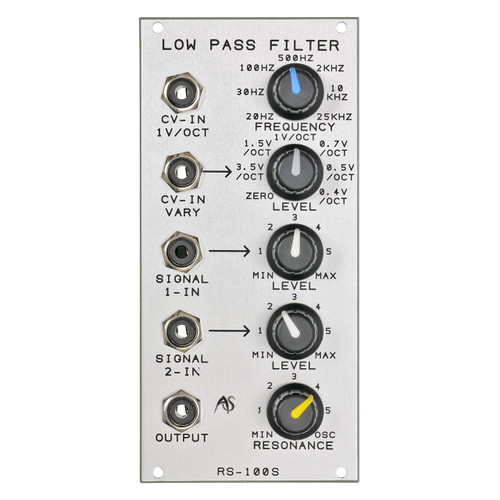


The RS-110N is a resonant analog multimode filter with excellent sound, resonance and four simultaneously available filter types.
The RS-110 is a resonant analog multimode filter with excellent sound, resonance and four simultaneously available filter types. An insert function in the feedback loop allows you to insert other audio processors.
The module has two audio inputs, each with a level control. "unity gain" is reached at position 4, beyond this the signal will be overdriven at the filter input.
The cutoff frequency can be set manually in a range of 30Hz to over 15kHz, with additional CVs even up to 50kHz.
Separate audio outputs for the four filter types are available: 24dB low pass, 24dB high pass, 12dB band pass and 12dB notch.
Resonance goes up to self-oscillation and besides that it offers an unique feature: the socket Res-Out and Res-In act like an insert i.e. they allow you to process the audio signal in the feedback loop by other audio processors like filters, distortions, delays, frequency shifters etc.
You get very wicked results when you connect the notch output with the resonance input. It sounds very metallic and the filter behaviour gets more aggressive. Generally it is fun to cross-connect the separate outputs with the CV and audio inputs and to use the filter in a modular way.
In use :
The RS-110N consists of a two channel audio mixer followed by four, parallel, resonant filters with voltage controlled frequency and a unique "insert" point in the feedback path that generates and controls resonance.
Filter Modes
The RS-110N offers four filter modes. These are 24dB/Oct low-pass , 24dB/Oct high-pass, 12dB/Oct band-pass and 12dB/Oct band reject (often called 'notch') filtering, with the cutoff frequencies (Fc) of the high-pass and low-pass outputs being the centre frequencies of the band-pass and notch outputs. Each of these filter characteristics is described in appendix 2.
There is no switch to select between the modes because all four are available simultaneously from the appropriate output sockets. However, the cut-off and resonance can not be defined individually for each, and the controls act upon each mode equally
You can determine Fc in the range 3Hz to 50kHz using combinations of the frequency control knob and the voltage control inputs.
CV-IN:
If you apply a CV conforming to the 1V/Oct standard, Fc will track the CV in exactly the same way as an RS-90 VCO would if you applied the same CV to its CV-IN 1V/Oct socket. If the CV is supplied from a keyboard then, in common parlance, the filter is tracking the keyboard 100% and, with the resonance at maximum, you can 'play' the filter as if it were a conventional oscillator.
You can also use this facility to make a notch or band-pass filter "track" the notes you are playing, and this can be used to create many special effects.
CV-IN VARY:
You may wish Fc to track incoming CVs differently, so the C V-IN VARY input is provided. This socket and its associated LEVEL control allow you to specify the filter's sensitivity to C Vs within the range ∞V/oct to approximately 0.4V/Oct. The former of these makes the filter invariant to incoming CVs, while the latter makes it oversensitive compared to CV-IN.
Resonance
The filters have a common resonance, 'Q', that you can control using the RESONANCE knob. In its fully anticlockwise position, Q is approximately zero, and there is no emphasis of the signal at Fc. As you rotate the knob clockwise Q will increase, whereupon every mode of the RS-110N will accentuate the harmonics that lie close to the cut-off frequency, Fc. Increasing Q further, the filters will exhibit ringing, and will severely colour any signals passed through them. Finally, if you continue to increase the resonance beyond a certain point, the filter will itself begin to oscillate, even in the absence of an input. Each mode will now produce a stable tone at the cutoff frequency determined by the various controls. This oscillation takes the form of (approximately) a sine wave, and it is produced by all four of the conventional audio outputs. The exact nature of the wave varies slightly from mode to mode, and you can use these subtle differences to create tonal variation when using the RS-110N as an oscillator.
Uses for RES OUT and RES IN include the introduction of voltage controlled resonance (achieved by routing the signal via an RS-180 VCA) or the creation of special effects (achieved by modifying the signal using devices such as reverb units).
FEEDBACK:
Resonance is produced by feeding part of a filter ’s output back into itself, thus creating a positive feedback loop. The RS-110N provides an unique facility, allowing you to break this loop and insert signals of your own choosing
RES OUT:
The signal path normally fed back to the filter's input can be broken by inserting a lead at this point. The signal thus tapped may then be presented to any other input in the Integrator. The RESONANCE control then acts as a LEVEL control for the tapped signal.
RES IN:
You may insert any signal here and it need not be derived from the RES OUT socket. Note, however, that taking a lead from RES OUT to RES IN does not replace the internal path because the internal circuit has a gain > 1.
Signal Inputs and Outputs
The RS-110N has two inputs: SIG 1 IN and SIG 2 IN, each with an associated LEVEL control. The inputs accept signals in the range ±10V, and these signals are mixed so that they can be filtered simultaneously.
The LEVEL controls offer unity gain in approximately the 2 o'clock position, marked '4' on the panel. At their fully anticlockwise position they attenuate the signal fully (MIN = -∞dB gain) while at their fully clockwise position they offer a small gain. This (or, indeed, any high level signal) allows you to 'overdrive' the filter.
There are four outputs, one for each mode, and these each carry a signal in the range ±10V.
- Width: 18HP
- Depth: 65mm
How much is my shipping?
Shipping costs are calculated automatically at checkout. Simply add items to your cart and proceed to the checkout page, where you'll see the available shipping options and their prices. VAT at the applicable rate for your country will also be displayed at checkout.
European Union orders:
- Standard shipping is free on orders over €100. Express shipping is available on orders over €100, and free on orders over €400.
- Free deliveryn and express delivery are not available to islands and remote areas including but not limited to Cyprus, Malta, Ceuta and more throughout the European Union. Add products to your cart and enter your address to confirm yoru shipping charge.
Poland orders:
- Standard shipping is free on orders over 250 PLN. Express shipping is free on orders over 500 PLN.
What about local taxes?
By default prices on the site include sales tax at 20%. The precise sales tax rate for your country will be calculated at checkout.
Do you ship to my country?
We ship to all EU member states from our warehouse in Warsaw, Poland. Add an item to your cart and enter your country and postcode to see the available shipping options and prices for your location. If you have any questions about shipping to your country, drop us an email at info@signalsounds.eu and we'll be happy to help.
Shipping methods
All EU orders are shipped via UPS. We offer two service levels:
- UPS Standard – our default shipping option. Delivery times vary by country (see estimated delivery times below).
- UPS Express Saver – next business day delivery to most EU destinations.
Each product page shows the estimated delivery time for your location, so you'll always know what to expect before you order.
Estimated delivery times (Standard shipping)
The times below are estimates in working days from dispatch, based on UPS Standard service. Express Saver delivers by the next business day to most destinations.
| Country | Estimated delivery (working days) |
|---|---|
| Austria | 2–3 |
| Belgium | 2 |
| Bulgaria | 4–5 |
| Croatia | 2–4 |
| Cyprus | 10 |
| Czechia | 2–3 |
| Denmark | 3 |
| Estonia | 2–3 |
| Finland | 3–5 |
| France | 2–4 |
| Germany | 2 |
| Greece | 5–7 |
| Hungary | 2–3 |
| Ireland | 4–6 |
| Italy | 3–5 |
| Latvia | 2–3 |
| Lithuania | 1–2 |
| Luxembourg | 2 |
| Malta | 5–7 |
| Netherlands | 2 |
| Poland | 1–2 |
| Portugal | 4–5 |
| Romania | 3–4 |
| Slovakia | 2–3 |
| Slovenia | 2–3 |
| Spain | 4 |
| Sweden | 3–5 |
These times are estimates and are not guaranteed. Delivery may occasionally take a little longer due to customs processing, local conditions, or carrier delays.
Dispatch times
Orders placed before 15:00 CET (Central European Time) on a working day are normally dispatched the same day. Orders placed after 15:00 CET, or on weekends and public holidays, will be dispatched on the next working day.
If you have an urgent order, please email us at info@signalsounds.eu before placing your order and we'll do our best to accommodate you.
Pre-orders
If a product is listed as a pre-order, it means we've ordered it from the supplier but it's not physically in stock yet. The product listing will include an estimated shipping date based on the best information we have from the supplier, but do bear in mind this is subject to change and is not a guaranteed date.
If you place an order containing a mixture of in-stock and pre-order items, we'll normally hold off on shipping anything until the pre-order item(s) have arrived, rather than splitting it into multiple shipments. If you need the in-stock items sooner, we'd recommend placing separate orders. As always, please get in touch at info@signalsounds.eu if you have questions.
Product Overview
The RS-110N is a resonant analog multimode filter with excellent sound, resonance and four simultaneously available filter types.
The RS-110 is a resonant analog multimode filter with excellent sound, resonance and four simultaneously available filter types. An insert function in the feedback loop allows you to insert other audio processors.
The module has two audio inputs, each with a level control. "unity gain" is reached at position 4, beyond this the signal will be overdriven at the filter input.
The cutoff frequency can be set manually in a range of 30Hz to over 15kHz, with additional CVs even up to 50kHz.
Separate audio outputs for the four filter types are available: 24dB low pass, 24dB high pass, 12dB band pass and 12dB notch.
Resonance goes up to self-oscillation and besides that it offers an unique feature: the socket Res-Out and Res-In act like an insert i.e. they allow you to process the audio signal in the feedback loop by other audio processors like filters, distortions, delays, frequency shifters etc.
You get very wicked results when you connect the notch output with the resonance input. It sounds very metallic and the filter behaviour gets more aggressive. Generally it is fun to cross-connect the separate outputs with the CV and audio inputs and to use the filter in a modular way.
In use :
The RS-110N consists of a two channel audio mixer followed by four, parallel, resonant filters with voltage controlled frequency and a unique "insert" point in the feedback path that generates and controls resonance.
Filter Modes
The RS-110N offers four filter modes. These are 24dB/Oct low-pass , 24dB/Oct high-pass, 12dB/Oct band-pass and 12dB/Oct band reject (often called 'notch') filtering, with the cutoff frequencies (Fc) of the high-pass and low-pass outputs being the centre frequencies of the band-pass and notch outputs. Each of these filter characteristics is described in appendix 2.
There is no switch to select between the modes because all four are available simultaneously from the appropriate output sockets. However, the cut-off and resonance can not be defined individually for each, and the controls act upon each mode equally
You can determine Fc in the range 3Hz to 50kHz using combinations of the frequency control knob and the voltage control inputs.
CV-IN:
If you apply a CV conforming to the 1V/Oct standard, Fc will track the CV in exactly the same way as an RS-90 VCO would if you applied the same CV to its CV-IN 1V/Oct socket. If the CV is supplied from a keyboard then, in common parlance, the filter is tracking the keyboard 100% and, with the resonance at maximum, you can 'play' the filter as if it were a conventional oscillator.
You can also use this facility to make a notch or band-pass filter "track" the notes you are playing, and this can be used to create many special effects.
CV-IN VARY:
You may wish Fc to track incoming CVs differently, so the C V-IN VARY input is provided. This socket and its associated LEVEL control allow you to specify the filter's sensitivity to C Vs within the range ∞V/oct to approximately 0.4V/Oct. The former of these makes the filter invariant to incoming CVs, while the latter makes it oversensitive compared to CV-IN.
Resonance
The filters have a common resonance, 'Q', that you can control using the RESONANCE knob. In its fully anticlockwise position, Q is approximately zero, and there is no emphasis of the signal at Fc. As you rotate the knob clockwise Q will increase, whereupon every mode of the RS-110N will accentuate the harmonics that lie close to the cut-off frequency, Fc. Increasing Q further, the filters will exhibit ringing, and will severely colour any signals passed through them. Finally, if you continue to increase the resonance beyond a certain point, the filter will itself begin to oscillate, even in the absence of an input. Each mode will now produce a stable tone at the cutoff frequency determined by the various controls. This oscillation takes the form of (approximately) a sine wave, and it is produced by all four of the conventional audio outputs. The exact nature of the wave varies slightly from mode to mode, and you can use these subtle differences to create tonal variation when using the RS-110N as an oscillator.
Uses for RES OUT and RES IN include the introduction of voltage controlled resonance (achieved by routing the signal via an RS-180 VCA) or the creation of special effects (achieved by modifying the signal using devices such as reverb units).
FEEDBACK:
Resonance is produced by feeding part of a filter ’s output back into itself, thus creating a positive feedback loop. The RS-110N provides an unique facility, allowing you to break this loop and insert signals of your own choosing
RES OUT:
The signal path normally fed back to the filter's input can be broken by inserting a lead at this point. The signal thus tapped may then be presented to any other input in the Integrator. The RESONANCE control then acts as a LEVEL control for the tapped signal.
RES IN:
You may insert any signal here and it need not be derived from the RES OUT socket. Note, however, that taking a lead from RES OUT to RES IN does not replace the internal path because the internal circuit has a gain > 1.
Signal Inputs and Outputs
The RS-110N has two inputs: SIG 1 IN and SIG 2 IN, each with an associated LEVEL control. The inputs accept signals in the range ±10V, and these signals are mixed so that they can be filtered simultaneously.
The LEVEL controls offer unity gain in approximately the 2 o'clock position, marked '4' on the panel. At their fully anticlockwise position they attenuate the signal fully (MIN = -∞dB gain) while at their fully clockwise position they offer a small gain. This (or, indeed, any high level signal) allows you to 'overdrive' the filter.
There are four outputs, one for each mode, and these each carry a signal in the range ±10V.
Technical Specs
Shipping Details
How much is my shipping?
Shipping costs are calculated automatically at checkout. Simply add items to your cart and proceed to the checkout page, where you'll see the available shipping options and their prices. VAT at the applicable rate for your country will also be displayed at checkout.
European Union orders:
- Standard shipping is free on orders over €100. Express shipping is available on orders over €100, and free on orders over €400.
- Free deliveryn and express delivery are not available to islands and remote areas including but not limited to Cyprus, Malta, Ceuta and more throughout the European Union. Add products to your cart and enter your address to confirm yoru shipping charge.
Poland orders:
- Standard shipping is free on orders over 250 PLN. Express shipping is free on orders over 500 PLN.
What about local taxes?
By default prices on the site include sales tax at 20%. The precise sales tax rate for your country will be calculated at checkout.
Do you ship to my country?
We ship to all EU member states from our warehouse in Warsaw, Poland. Add an item to your cart and enter your country and postcode to see the available shipping options and prices for your location. If you have any questions about shipping to your country, drop us an email at info@signalsounds.eu and we'll be happy to help.
Shipping methods
All EU orders are shipped via UPS. We offer two service levels:
- UPS Standard – our default shipping option. Delivery times vary by country (see estimated delivery times below).
- UPS Express Saver – next business day delivery to most EU destinations.
Each product page shows the estimated delivery time for your location, so you'll always know what to expect before you order.
Estimated delivery times (Standard shipping)
The times below are estimates in working days from dispatch, based on UPS Standard service. Express Saver delivers by the next business day to most destinations.
| Country | Estimated delivery (working days) |
|---|---|
| Austria | 2–3 |
| Belgium | 2 |
| Bulgaria | 4–5 |
| Croatia | 2–4 |
| Cyprus | 10 |
| Czechia | 2–3 |
| Denmark | 3 |
| Estonia | 2–3 |
| Finland | 3–5 |
| France | 2–4 |
| Germany | 2 |
| Greece | 5–7 |
| Hungary | 2–3 |
| Ireland | 4–6 |
| Italy | 3–5 |
| Latvia | 2–3 |
| Lithuania | 1–2 |
| Luxembourg | 2 |
| Malta | 5–7 |
| Netherlands | 2 |
| Poland | 1–2 |
| Portugal | 4–5 |
| Romania | 3–4 |
| Slovakia | 2–3 |
| Slovenia | 2–3 |
| Spain | 4 |
| Sweden | 3–5 |
These times are estimates and are not guaranteed. Delivery may occasionally take a little longer due to customs processing, local conditions, or carrier delays.
Dispatch times
Orders placed before 15:00 CET (Central European Time) on a working day are normally dispatched the same day. Orders placed after 15:00 CET, or on weekends and public holidays, will be dispatched on the next working day.
If you have an urgent order, please email us at info@signalsounds.eu before placing your order and we'll do our best to accommodate you.
Pre-orders
If a product is listed as a pre-order, it means we've ordered it from the supplier but it's not physically in stock yet. The product listing will include an estimated shipping date based on the best information we have from the supplier, but do bear in mind this is subject to change and is not a guaranteed date.
If you place an order containing a mixture of in-stock and pre-order items, we'll normally hold off on shipping anything until the pre-order item(s) have arrived, rather than splitting it into multiple shipments. If you need the in-stock items sooner, we'd recommend placing separate orders. As always, please get in touch at info@signalsounds.eu if you have questions.