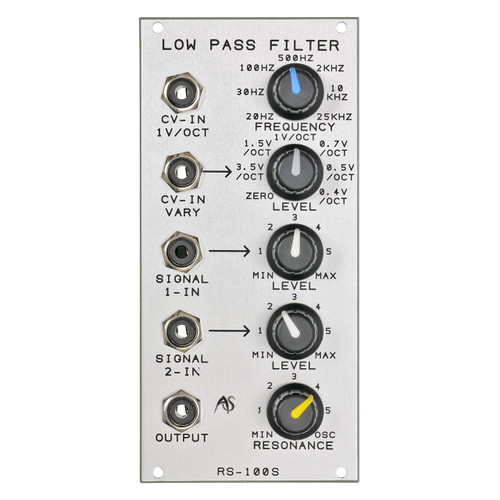


Genuine Ems synthi filter. This legendary filter can be switched between pre 1974 and post 1974 filter type and response. For the first time, response can be voltage controlled which was designed on the circuit board but not available on the matrix. This module is made under license from Ems. It has a new front panel design with elongated holes.
The various models of EMS VCS3 and Synthi rank among the most desirable of all vintage synthesizers. Designed in England between the late 1960s and mid 1980s, these eschewed common designs and control mechanisms, and performed very differently from synthesizers manufactured in America and Japan. The earliest commercial Synthi (although not called by that name) and by far the most famous, was the VCS3. This was later joined by the Synthi A, Synthi AKS, the monstrous Synthi100, and the Synthi E. (For further information about these,please refer to the chapter entitled "The EMS Story" found before the appendices in this manual.) The RS-500N low-pass filter for the RS Integrator was recreated by former EMS engineer Steve Gay and is, as far as possible, an exact reproduction of the filter within these synthesizers. Although there are minor differences between the circuitry in the RS-500N and the originals, most have been made specifically so that the EMS circuit will fit the RS Integrator format. Other modifications allow it to handle modern signal levels and control voltages. In addition, the RS-500N offers three facilities not found on unmodified EMS synthesizers. These allow you to use the filter in ways not possible on an original Synthi. The additional facilities are:
Voltage Control of Response
"Response" was the EMS term for filter resonance. EMS synthesizers allowed you to alter this using a knob, but they did not provide for voltage control. Fortunately, it has been simple to add a CV input to control the Response. This has not altered the filter's sound.
Rapid Cut-Off Frequency response to incoming CVs
Due to a capacitor that slewed incoming control voltages, the cut-off frequencies of early EMS filters responded slowly to changes in incoming CVs. The consequence of this was obvious when you tried to create snappy, percussive sounds on a Synthi... you couldn't. The RS-500N allows you to switch this capacitor out of the circuit, allowing you to program significantly different types of sound.
18dB/octave and 24dB/octave filter slopes
Until early 1974, all VCS3s and Synthis were fitted with filters that rolled-off at 18dB/octave. But in response to market forces, later models offered the more common slope of 24dB/octave. Although this was in some respects an improvement, it came at a price... the sound of the filter changed, and many players stated a preference for the earlier design.
Happily, you don't have to choose between one or the other when configuring your RS Integrator. The RS-500N offers both filter characteristics, selectable using a simple front-panel switch.
Note: The CV slew switch and the 18dB/24dB filter options were - and remain - standard modifications for vintage EMS instruments.
In use :
The RS-500N is a low-pass filter with variable resonance. It is modelled on the filters produced for EMS synthesisers, and shares their principle sonic characteristics.
Cutoff Frequency
You control the filter cut-off frequency (Fc) using the FREQUENCY control. In its fully anticlockwise position, Fc is approximately 20Hz. As you rotate the knob clockwise Fc will increase until, it its fully clockwise position, it reaches approximately 20kHz. These extreme positions are called 'Low' and 'High' respectively. You may also control Fc using one or both of the CV inputs:
CV-IN FIXED:
Unlike other RS Integrator filters (which will track an incoming 1V/oct CV accurately over a wide range frequencies) the fixed input on the RS-500N is not strictly a 1V/oct CV input. It is calibrated to respond to 1V/oct as well as possible, but it is one of the quirks of the original EMS design that it is not linear enough to track over a range greater than about two octaves
CV-IN VARY:
You may wish Fc to track incoming CVs at >100% or <100% relative to 1V/oct, so a CV-IN VARY input is provided. This socket and its associated LEVEL control allow you to specify the filter's sensitivity to CVs within the range ∞V/oct to approximately 0.2V/oct. The former of these makes the filter invariant to incoming CVs, while the latter makes it over-sensitive compared to the FIXED input.
Cutoff Frequency Slew
The RS-500N offers two CV response modes: CV SLEW FAST and CV SLEW SLOW (STD). You should select the correct mode for the type of sound required.
CV SLEW SLOW (Standard):
When high frequency CVs are applied to the unmodified Synthi filter they are low-pass filtered by a slewing capacitor. This means that the filter will not respond to high frequency CVs, and will respond slowly to rapid changes in incoming CVs. You can use this mode to recreate the bubbling and warbling effects for which early VCS3s and Synthis are famous.
CV-SLEW FAST:
With the switch in this position, the slewing capacitor is removed from the CV input circuitry, so the filter will respond to high frequency CVs. Use this mode for sounds such as percussion and effects that require a rapidly varying filter cut-off frequency
Filter Slope
Changing the filter slope alters the way in which upper frequencies are removed from an audio signal passing through the device. This change can be subtle or obvious, and can be the single most defining characteristic of an analogue synthesizer.
PRE 1974:
The filter attenuates frequencies above Fc at a rate of 18dB/oct. This recreates sounds of EMS synthesisers built before 1974.
POST 1974:
The filter attenuates frequencies above Fc at a rate of 24dB/oct. This recreates sounds of EMS synthesisers built from 1974 onwards.
Response
The RS-500N has variable resonance, which on early EMS synthesizers was called "Response".
As this is increased from its minimum, the filter will accentuate Fc, and will attenuate frequencies below Fc as well as those above it. As the resonance is increased further, the RS-500N will exhibit 'ringing', and will strongly color any signal passing through it. At high resonance, the filter will begin to oscillate, and it will then act as an audio signal generator, the frequency of which is Fc itself.
You can control the resonance using the RESPONSE control. In its fully anticlockwise position, the resonance is approximately zero, and there is no emphasis of the signal at Fc. As you rotate the knob clockwise, the resonance will increase until, it its fully clockwise position, the filter oscillates. You may also control the filter resonance using the RESPONSE CV-IN, which accepts and responds to all standard RS Integrator control voltages.
Audio Input and Output
The RS-500N has a single audio input: SIG IN, with an associated LEVEL control. This input accepts signals in the range ±10v.
The LEVEL control offers unity gain in approximately the 2 o'clock position, marked '4' on the panel. At its fully anticlockwise position it attenuates the signal fully (MIN = -∞dB gain) while at its fully clockwise position it offers a small gain.
There is a single output with an associated LEVEL control. This carries a signal in the range ±10v.
COPYRIGHT NOTICE
The filter circuit incorporated in the RS-500N is used under a licence granted to Analogue Systems Ltd by EMS Ltd. The name EMS is used under a licence granted to Analogue Systems Ltd by EMS Ltd. All rights reserved.
- Width: 12HP
- Depth: 65mm
- Power: 35 mA +12V / 70 mA -12V / 0 mA 5V
How much is my shipping?
Shipping costs are calculated automatically at checkout. Simply add items to your cart and proceed to the checkout page, where you'll see the available shipping options and their prices. VAT at the applicable rate for your country will also be displayed at checkout.
European Union orders:
- Standard shipping is free on orders over €100. Express shipping is available on orders over €100, and free on orders over €400.
- Free deliveryn and express delivery are not available to islands and remote areas including but not limited to Cyprus, Malta, Ceuta and more throughout the European Union. Add products to your cart and enter your address to confirm yoru shipping charge.
Poland orders:
- Standard shipping is free on orders over 250 PLN. Express shipping is free on orders over 500 PLN.
What about local taxes?
By default prices on the site include sales tax at 20%. The precise sales tax rate for your country will be calculated at checkout.
Do you ship to my country?
We ship to all EU member states from our warehouse in Warsaw, Poland. Add an item to your cart and enter your country and postcode to see the available shipping options and prices for your location. If you have any questions about shipping to your country, drop us an email at info@signalsounds.eu and we'll be happy to help.
Shipping methods
All EU orders are shipped via UPS. We offer two service levels:
- UPS Standard – our default shipping option. Delivery times vary by country (see estimated delivery times below).
- UPS Express Saver – next business day delivery to most EU destinations.
Each product page shows the estimated delivery time for your location, so you'll always know what to expect before you order.
Estimated delivery times (Standard shipping)
The times below are estimates in working days from dispatch, based on UPS Standard service. Express Saver delivers by the next business day to most destinations.
| Country | Estimated delivery (working days) |
|---|---|
| Austria | 2–3 |
| Belgium | 2 |
| Bulgaria | 4–5 |
| Croatia | 2–4 |
| Cyprus | 10 |
| Czechia | 2–3 |
| Denmark | 3 |
| Estonia | 2–3 |
| Finland | 3–5 |
| France | 2–4 |
| Germany | 2 |
| Greece | 5–7 |
| Hungary | 2–3 |
| Ireland | 4–6 |
| Italy | 3–5 |
| Latvia | 2–3 |
| Lithuania | 1–2 |
| Luxembourg | 2 |
| Malta | 5–7 |
| Netherlands | 2 |
| Poland | 1–2 |
| Portugal | 4–5 |
| Romania | 3–4 |
| Slovakia | 2–3 |
| Slovenia | 2–3 |
| Spain | 4 |
| Sweden | 3–5 |
These times are estimates and are not guaranteed. Delivery may occasionally take a little longer due to customs processing, local conditions, or carrier delays.
Dispatch times
Orders placed before 15:00 CET (Central European Time) on a working day are normally dispatched the same day. Orders placed after 15:00 CET, or on weekends and public holidays, will be dispatched on the next working day.
If you have an urgent order, please email us at info@signalsounds.eu before placing your order and we'll do our best to accommodate you.
Pre-orders
If a product is listed as a pre-order, it means we've ordered it from the supplier but it's not physically in stock yet. The product listing will include an estimated shipping date based on the best information we have from the supplier, but do bear in mind this is subject to change and is not a guaranteed date.
If you place an order containing a mixture of in-stock and pre-order items, we'll normally hold off on shipping anything until the pre-order item(s) have arrived, rather than splitting it into multiple shipments. If you need the in-stock items sooner, we'd recommend placing separate orders. As always, please get in touch at info@signalsounds.eu if you have questions.
Product Overview
Genuine Ems synthi filter. This legendary filter can be switched between pre 1974 and post 1974 filter type and response. For the first time, response can be voltage controlled which was designed on the circuit board but not available on the matrix. This module is made under license from Ems. It has a new front panel design with elongated holes.
The various models of EMS VCS3 and Synthi rank among the most desirable of all vintage synthesizers. Designed in England between the late 1960s and mid 1980s, these eschewed common designs and control mechanisms, and performed very differently from synthesizers manufactured in America and Japan. The earliest commercial Synthi (although not called by that name) and by far the most famous, was the VCS3. This was later joined by the Synthi A, Synthi AKS, the monstrous Synthi100, and the Synthi E. (For further information about these,please refer to the chapter entitled "The EMS Story" found before the appendices in this manual.) The RS-500N low-pass filter for the RS Integrator was recreated by former EMS engineer Steve Gay and is, as far as possible, an exact reproduction of the filter within these synthesizers. Although there are minor differences between the circuitry in the RS-500N and the originals, most have been made specifically so that the EMS circuit will fit the RS Integrator format. Other modifications allow it to handle modern signal levels and control voltages. In addition, the RS-500N offers three facilities not found on unmodified EMS synthesizers. These allow you to use the filter in ways not possible on an original Synthi. The additional facilities are:
Voltage Control of Response
"Response" was the EMS term for filter resonance. EMS synthesizers allowed you to alter this using a knob, but they did not provide for voltage control. Fortunately, it has been simple to add a CV input to control the Response. This has not altered the filter's sound.
Rapid Cut-Off Frequency response to incoming CVs
Due to a capacitor that slewed incoming control voltages, the cut-off frequencies of early EMS filters responded slowly to changes in incoming CVs. The consequence of this was obvious when you tried to create snappy, percussive sounds on a Synthi... you couldn't. The RS-500N allows you to switch this capacitor out of the circuit, allowing you to program significantly different types of sound.
18dB/octave and 24dB/octave filter slopes
Until early 1974, all VCS3s and Synthis were fitted with filters that rolled-off at 18dB/octave. But in response to market forces, later models offered the more common slope of 24dB/octave. Although this was in some respects an improvement, it came at a price... the sound of the filter changed, and many players stated a preference for the earlier design.
Happily, you don't have to choose between one or the other when configuring your RS Integrator. The RS-500N offers both filter characteristics, selectable using a simple front-panel switch.
Note: The CV slew switch and the 18dB/24dB filter options were - and remain - standard modifications for vintage EMS instruments.
In use :
The RS-500N is a low-pass filter with variable resonance. It is modelled on the filters produced for EMS synthesisers, and shares their principle sonic characteristics.
Cutoff Frequency
You control the filter cut-off frequency (Fc) using the FREQUENCY control. In its fully anticlockwise position, Fc is approximately 20Hz. As you rotate the knob clockwise Fc will increase until, it its fully clockwise position, it reaches approximately 20kHz. These extreme positions are called 'Low' and 'High' respectively. You may also control Fc using one or both of the CV inputs:
CV-IN FIXED:
Unlike other RS Integrator filters (which will track an incoming 1V/oct CV accurately over a wide range frequencies) the fixed input on the RS-500N is not strictly a 1V/oct CV input. It is calibrated to respond to 1V/oct as well as possible, but it is one of the quirks of the original EMS design that it is not linear enough to track over a range greater than about two octaves
CV-IN VARY:
You may wish Fc to track incoming CVs at >100% or <100% relative to 1V/oct, so a CV-IN VARY input is provided. This socket and its associated LEVEL control allow you to specify the filter's sensitivity to CVs within the range ∞V/oct to approximately 0.2V/oct. The former of these makes the filter invariant to incoming CVs, while the latter makes it over-sensitive compared to the FIXED input.
Cutoff Frequency Slew
The RS-500N offers two CV response modes: CV SLEW FAST and CV SLEW SLOW (STD). You should select the correct mode for the type of sound required.
CV SLEW SLOW (Standard):
When high frequency CVs are applied to the unmodified Synthi filter they are low-pass filtered by a slewing capacitor. This means that the filter will not respond to high frequency CVs, and will respond slowly to rapid changes in incoming CVs. You can use this mode to recreate the bubbling and warbling effects for which early VCS3s and Synthis are famous.
CV-SLEW FAST:
With the switch in this position, the slewing capacitor is removed from the CV input circuitry, so the filter will respond to high frequency CVs. Use this mode for sounds such as percussion and effects that require a rapidly varying filter cut-off frequency
Filter Slope
Changing the filter slope alters the way in which upper frequencies are removed from an audio signal passing through the device. This change can be subtle or obvious, and can be the single most defining characteristic of an analogue synthesizer.
PRE 1974:
The filter attenuates frequencies above Fc at a rate of 18dB/oct. This recreates sounds of EMS synthesisers built before 1974.
POST 1974:
The filter attenuates frequencies above Fc at a rate of 24dB/oct. This recreates sounds of EMS synthesisers built from 1974 onwards.
Response
The RS-500N has variable resonance, which on early EMS synthesizers was called "Response".
As this is increased from its minimum, the filter will accentuate Fc, and will attenuate frequencies below Fc as well as those above it. As the resonance is increased further, the RS-500N will exhibit 'ringing', and will strongly color any signal passing through it. At high resonance, the filter will begin to oscillate, and it will then act as an audio signal generator, the frequency of which is Fc itself.
You can control the resonance using the RESPONSE control. In its fully anticlockwise position, the resonance is approximately zero, and there is no emphasis of the signal at Fc. As you rotate the knob clockwise, the resonance will increase until, it its fully clockwise position, the filter oscillates. You may also control the filter resonance using the RESPONSE CV-IN, which accepts and responds to all standard RS Integrator control voltages.
Audio Input and Output
The RS-500N has a single audio input: SIG IN, with an associated LEVEL control. This input accepts signals in the range ±10v.
The LEVEL control offers unity gain in approximately the 2 o'clock position, marked '4' on the panel. At its fully anticlockwise position it attenuates the signal fully (MIN = -∞dB gain) while at its fully clockwise position it offers a small gain.
There is a single output with an associated LEVEL control. This carries a signal in the range ±10v.
COPYRIGHT NOTICE
The filter circuit incorporated in the RS-500N is used under a licence granted to Analogue Systems Ltd by EMS Ltd. The name EMS is used under a licence granted to Analogue Systems Ltd by EMS Ltd. All rights reserved.
Technical Specs
Shipping Details
How much is my shipping?
Shipping costs are calculated automatically at checkout. Simply add items to your cart and proceed to the checkout page, where you'll see the available shipping options and their prices. VAT at the applicable rate for your country will also be displayed at checkout.
European Union orders:
- Standard shipping is free on orders over €100. Express shipping is available on orders over €100, and free on orders over €400.
- Free deliveryn and express delivery are not available to islands and remote areas including but not limited to Cyprus, Malta, Ceuta and more throughout the European Union. Add products to your cart and enter your address to confirm yoru shipping charge.
Poland orders:
- Standard shipping is free on orders over 250 PLN. Express shipping is free on orders over 500 PLN.
What about local taxes?
By default prices on the site include sales tax at 20%. The precise sales tax rate for your country will be calculated at checkout.
Do you ship to my country?
We ship to all EU member states from our warehouse in Warsaw, Poland. Add an item to your cart and enter your country and postcode to see the available shipping options and prices for your location. If you have any questions about shipping to your country, drop us an email at info@signalsounds.eu and we'll be happy to help.
Shipping methods
All EU orders are shipped via UPS. We offer two service levels:
- UPS Standard – our default shipping option. Delivery times vary by country (see estimated delivery times below).
- UPS Express Saver – next business day delivery to most EU destinations.
Each product page shows the estimated delivery time for your location, so you'll always know what to expect before you order.
Estimated delivery times (Standard shipping)
The times below are estimates in working days from dispatch, based on UPS Standard service. Express Saver delivers by the next business day to most destinations.
| Country | Estimated delivery (working days) |
|---|---|
| Austria | 2–3 |
| Belgium | 2 |
| Bulgaria | 4–5 |
| Croatia | 2–4 |
| Cyprus | 10 |
| Czechia | 2–3 |
| Denmark | 3 |
| Estonia | 2–3 |
| Finland | 3–5 |
| France | 2–4 |
| Germany | 2 |
| Greece | 5–7 |
| Hungary | 2–3 |
| Ireland | 4–6 |
| Italy | 3–5 |
| Latvia | 2–3 |
| Lithuania | 1–2 |
| Luxembourg | 2 |
| Malta | 5–7 |
| Netherlands | 2 |
| Poland | 1–2 |
| Portugal | 4–5 |
| Romania | 3–4 |
| Slovakia | 2–3 |
| Slovenia | 2–3 |
| Spain | 4 |
| Sweden | 3–5 |
These times are estimates and are not guaranteed. Delivery may occasionally take a little longer due to customs processing, local conditions, or carrier delays.
Dispatch times
Orders placed before 15:00 CET (Central European Time) on a working day are normally dispatched the same day. Orders placed after 15:00 CET, or on weekends and public holidays, will be dispatched on the next working day.
If you have an urgent order, please email us at info@signalsounds.eu before placing your order and we'll do our best to accommodate you.
Pre-orders
If a product is listed as a pre-order, it means we've ordered it from the supplier but it's not physically in stock yet. The product listing will include an estimated shipping date based on the best information we have from the supplier, but do bear in mind this is subject to change and is not a guaranteed date.
If you place an order containing a mixture of in-stock and pre-order items, we'll normally hold off on shipping anything until the pre-order item(s) have arrived, rather than splitting it into multiple shipments. If you need the in-stock items sooner, we'd recommend placing separate orders. As always, please get in touch at info@signalsounds.eu if you have questions.